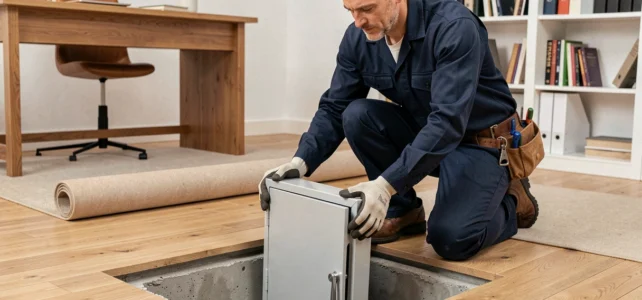
A safe placed in a closet can be ripped out in a matter of minutes by a burglar equipped with a crowbar. Sealed in a concrete slab, that same safe becomes almost immovable. The difference lies not in the model chosen, but in how it is anchored to the ground, and the direct consequences on your insurance coverage.
Ground anchoring and insurance contract: a condition often overlooked
Have you ever checked what your home insurance policy states in case of theft of the contents of a safe? Most insurers impose a specific condition: the safe must be anchored in a load-bearing concrete support if it weighs less than 1,000 kg.
A safe simply placed on the floor or on a shelf, even certified according to a high-security standard, can lead to the nullification of the theft coverage on its contents. In other words, you pay a premium, but the insurer does not compensate you if the safe is not secured.
This requirement exists because an unanchored safe can be taken away. A burglar does not need to open it on-site: they load it up and open it elsewhere, without time pressure. Anchoring eliminates this scenario. That is why choosing a safe to be anchored in the ground meets both a need for physical security and a contractual obligation.
Class EN 1143-1 and insurable value: how ground anchoring changes the ceiling
The European standard EN 1143-1 classifies safes according to their resistance to burglary, from Class 0 to higher levels. Each class corresponds to a ceiling of insurable values, meaning the maximum amount the insurer agrees to cover.
What many individuals do not realize is that the ceiling depends on both the class of the safe and the quality of its anchoring. A Class I safe properly anchored in a slab can cover a significantly higher amount than a similarly classed safe simply placed.
What the class of the safe concretely determines
The class reflects the time and tools needed to force the safe during standardized tests. The higher the class, the longer the safe withstands mechanical and thermal attacks.
For an individual storing jewelry, documents, or cash, the class directly influences the amount reimbursed in the event of a claim. Moving up a class without anchoring the safe in the ground means paying more for a level of protection that the insurer will not fully recognize.
Physical resistance of the safe anchored in the ground: what happens during a burglary
A placed safe, even heavy, remains vulnerable to three common techniques: tipping, leveraging, and ripping. An experienced burglar works quickly. Tipping over a safe weighing a few dozen kilos takes only a few seconds.
A safe anchored in a concrete slab cannot be tipped, ripped, or taken away. The burglar only has access to the door. The other five sides are trapped by the support.
Why the ground rather than the wall
Wall anchoring is also an option, but it has a limitation: not all walls are load-bearing. A drywall or hollow brick partition offers no real resistance. A concrete slab floor, on the other hand, is almost always a load-bearing support in a house or apartment.
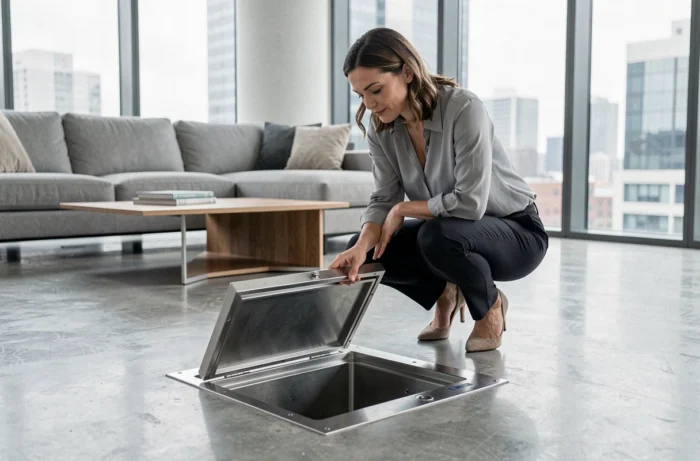
The ground has another advantage. A safe embedded in the floor can be hidden under a covering, a piece of furniture, or a rug. A wall safe remains visible, even behind a painting. The discretion of a floor safe adds a layer of passive protection: what a burglar cannot find, they cannot attack.
Criteria for choosing a safe to be anchored in the ground
Before purchasing, several technical parameters need to be checked. Not all are obvious at first glance.
- Class EN 1143-1: it determines the level of resistance to burglary and the ceiling of insurable values. Check the class required by your insurance policy before choosing.
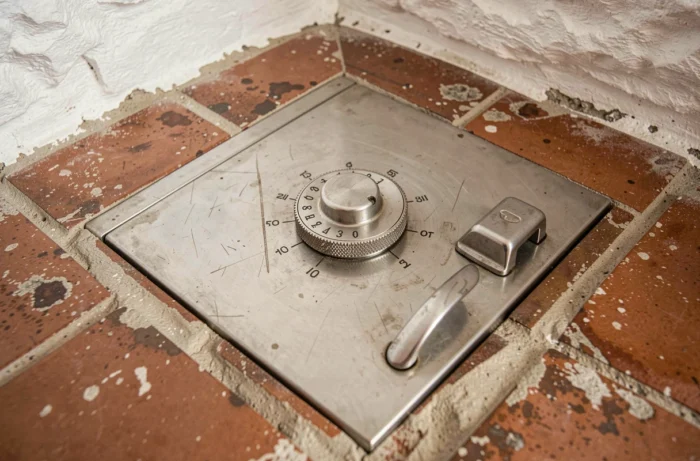
- Type of lock: key lock, mechanical combination, or electronic locking. Each system has its constraints (lost key, battery failure, forgotten code). Some safes combine two systems to offset these risks.
- Compatibility with your slab: the floor must be solid concrete, thick enough to accommodate the anchoring bolts. A technical floor, wooden flooring, or a thin screed are not suitable without prior work.
- Usable volume: a floor safe often has a compact format. List precisely what you plan to store (A4 documents, jewelry boxes, digital media) to avoid ending up with too little space.
Fire protection: a bonus, not a given
Not all safes are fireproof. Fire resistance is subject to a separate standard. If you store paper documents, digital media, or photographs, check that the safe has a fire resistance certification, in addition to the anti-burglary standard.
A safe anchored in the ground benefits from partial natural thermal protection: the surrounding concrete acts as an insulator. This is not enough to replace a fireproof certification, but it slows the temperature rise compared to a placed safe exposed on four sides.
Ground anchoring: what to remember before deciding
The safe anchored in the ground protects your belongings on three simultaneous levels. It physically prevents ripping. It meets the anchoring conditions required by insurers. And it offers a discretion that other placement methods do not allow.
Check your insurance policy before purchasing your safe. The insurable amount, the required class, and the obligation of anchoring are included. A poorly secured safe, no matter how efficient, does not protect you against theft or against refusal of compensation.