
Domestic fuel oil remains the primary heating method for several million households in France, and the question of the cost to fill a tank arises each year with the same urgency. In August 2026, the national average for 1000 liters of ordinary fuel oil is around 1,681 euros, delivery included. This price masks significant discrepancies depending on the departments, the quantity ordered, and the timing of the purchase.
Domestic fuel oil versus gas and electricity: where does the bill stand in 2026
Before looking at the trends for fuel oil alone, it is useful to compare it with other energy sources. The reports published by the Ministry of Ecological Transition in August 2026 show a trend that may be surprising.
Between 2024 and 2025, the price of fuel oil decreased by about 6% year-on-year. At the same time, natural gas for households increased by about 8.6%, while electricity fell by about 9%. Fuel oil thus finds itself in an intermediate position: cheaper than a year earlier, but still subject to fluctuations in crude oil prices.
This comparison is rarely highlighted by specialized websites selling fuel oil. To track the price of domestic fuel oil today and place it in the overall context of energy, one must cross-reference several sources rather than relying on a single comparator.
Do you heat with fuel oil and wonder if switching to gas would be more advantageous? In 2026, the answer is not as obvious as it was two years ago, precisely because gas has taken the opposite path to fuel oil.
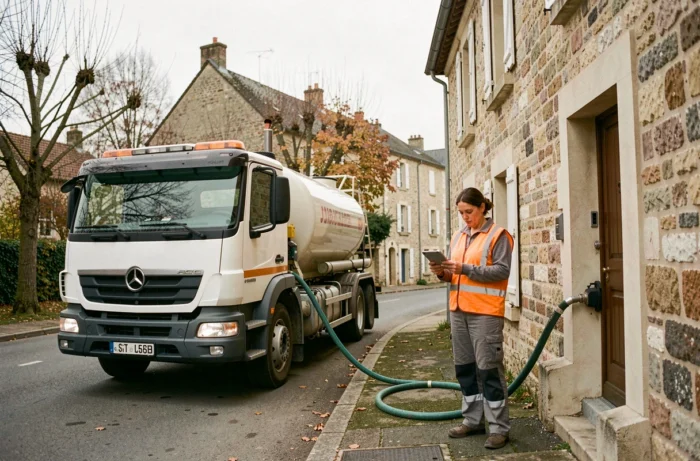
What causes the price of 1000 liters of fuel oil to vary from one department to another
The average national price does not reflect anyone’s reality. Two parameters weigh much more than the price of oil on the final bill of an individual.
Distance between the tank, the depot, and the refinery
The transportation cost represents a significant portion of the price per liter. A household located near a petroleum depot in a port area will pay less than a home isolated in the average mountains. Geographical distance can vary the price by several cents per liter, which can amount to several dozen euros on an order of 1000 liters.
Volume ordered and ordering method
Ordering 1000 liters costs proportionally more per liter than ordering 2000 liters. The truck makes a single trip in both cases, and the logistical costs are spread over a larger volume.
Group orders, where several neighbors order together, further reduce the bill. This lever is underutilized even though it represents one of the few means of direct action for the consumer.
- The distance from depot to tank determines delivery costs, sometimes more than the price of oil itself.
- The volume ordered affects the unit price: the larger the order, the lower the price per liter.
- Group ordering shares transportation costs among several households in the same geographical area.
- The time of year matters: ordering in summer, outside peak demand, often allows for a better rate.

Why public aid does not cover the purchase of fuel oil
Are you hoping for assistance to lighten the cost of filling your tank? Current programs do not work in that direction. MaPrimeRénov’ and CEE (Energy Savings Certificates) grants fund the replacement of a fuel oil boiler with another system: heat pump, biomass boiler, connection to a heating network, or solar installation.
No public aid subsidizes the purchase of fuel oil or the replacement of one fuel oil boiler with another fuel oil boiler. The logic of public authorities aims for the gradual exit from fuel oil in the residential sector, not its maintenance.
This orientation has a direct consequence on the value of a property heated with fuel oil. Buyers increasingly factor in the cost of conversion in their estimates, which weighs on the resale price of homes equipped with an old fuel oil boiler.
Should you buy now or wait to fill your tank
The price of fuel oil follows that of crude oil, but with a delay and local filters. Geopolitical tensions, OPEC decisions, and the level of global demand influence the barrel price. For an individual, anticipating these movements is speculative.
Some practical benchmarks remain useful:
- Prices are generally lower between April and July, when heating demand is low.
- During periods of intense cold, demand suddenly increases and prices follow.
- Ordering before the September return often helps avoid the autumn peak, when households fill their tanks in anticipation of winter.
Premium fuel oil, which contains additives to improve combustion and protect the boiler, is priced slightly above ordinary fuel oil. In August 2026, the difference is around a few dozen euros for 1000 liters. This difference remains modest considering the lifespan of the boiler that premium fuel oil helps to preserve.

The price of 1000 liters of fuel oil in France depends as much on your postal code and your order date as on the global price of oil. With a national average close to 1,681 euros for ordinary fuel oil in August 2026, the time remains quite favorable to fill your tank before winter.
The real question in the medium term is not the price of the next fill-up, but that of the transition to another heating method, since all public aid pushes towards the exit from fuel oil.