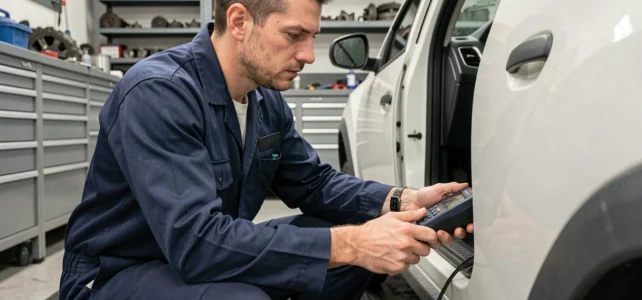
The DTC038061 code corresponds to Renault’s translation of the OBD standard P0380, but its management by the engine control unit goes beyond a simple glow plug fault. On K9K (1.5 dCi) engines and their Dacia variants, this code is associated with the internal fault DF025, which points to an interruption in the diagnostic circuit of the glow plug chain, and not just a burnt component.
ECM Relay Monitoring Circuit: The True Scope of DTC038061
A generic P0380 triggered on a non-Renault vehicle almost always indicates a faulty glow plug. On recent Renault and Dacia architectures, the engine control unit (ECM) actively monitors the electrical connection between itself and the glow plug relay. When this monitoring loop detects an inconsistency, even if each glow plug tested individually with a multimeter shows a correct resistance, the DTC038061 is recorded.
We regularly observe in the workshop vehicles where all four glow plugs are functional, but where a wiring fault between the ECM and the relay triggers the code. Only looking at the glow plugs wastes time. The reliable procedure begins with checking the harness connecting the control unit to the glow plug box, including connectors. To better understand the dtc038061 at Renault and Dacia, this monitoring circuit logic specific to the manufacturer must be integrated.
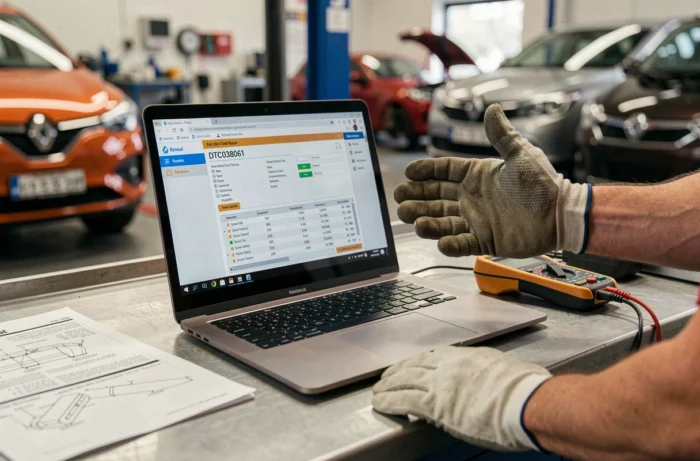
Diesel Preheating Diagnosis: Sequential Testing Method
Starting the diagnosis without a method leads to unnecessary parts replacements. We recommend a strict four-step sequence.
- Visual inspection of the electrical harness between the engine control unit and the glow plug relay: look for signs of oxidation, loose terminals, melted or corroded sheathing. On Dacia Duster and Sandero, the passage of the harness near the exhaust manifold often causes thermal damage.
- Check the fuse dedicated to the preheating circuit, then measure the supply voltage at the relay, with the engine off and the ignition on. An absent or unstable voltage at this stage eliminates the possibility of faulty glow plugs.
- Individual testing of each glow plug with a multimeter in resistance mode. A glow plug with an open circuit or showing an abnormally high resistance compared to the others should be replaced.
- Check the glow plug relay itself: measure the continuity of its outputs and ensure it switches correctly when the ignition is turned on. A stuck or burnt relay triggers the DTC038061 just as much as a faulty glow plug.
This sequence allows for isolating the faulty component without multiplying parts purchases. The glow plug relay is often overlooked even though it accounts for a significant portion of the cases encountered.
Glow Plug References for Renault and Dacia: Cross Compatibility
The Renault references 110659823R and 110654876R cover a much wider range of models than one might assume. Clio, Mégane, Kadjar, Captur, Kangoo on the Renault side, but also Duster, Sandero, Logan, and Dokker on the Dacia side are concerned. These same references equip certain Nissan models (Qashqai, Juke) and Mercedes (Class A, Class B) sharing the K9K engine base or its evolutions.
This cross compatibility has a concrete advantage: the availability of parts is excellent, and prices remain reasonable due to production volumes. However, installing an unsuitable heat temperature glow plug for the control unit’s calibration can generate a new fault. Checking the exact reference in the manufacturer’s catalog before ordering avoids this pitfall.
Glow Plug Relay: Do Not Confuse Generations
Renault has evolved its glow plug boxes over the years in line with pollution standards. A relay designed for a K9K Euro 5 does not have the same timing map as a Euro 6 model. Installing a relay from an earlier generation can cause preheating that is too short or too long, leading to difficult starts in cold weather or excessive fuel consumption.
Consequences of Ignoring a DTC038061 on the Diesel Engine
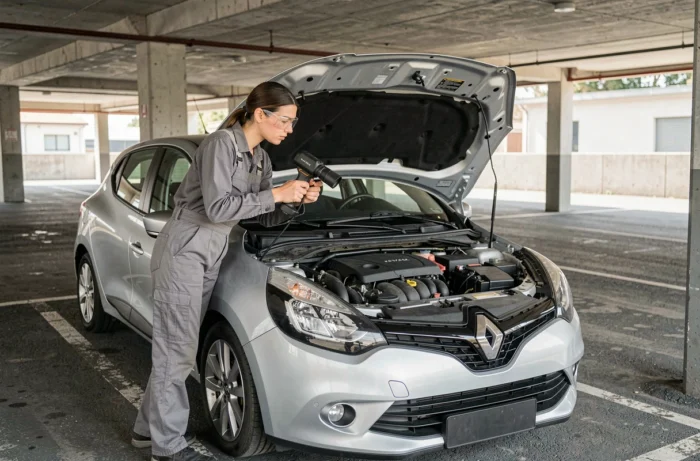
A faulty preheating circuit is not limited to a warning light on the dashboard. When the combustion chamber temperature is insufficient at startup, the diesel fuel does not ignite properly. Unburnt fuel increases, white or gray smoke at startup becomes recurrent, and the particulate filter takes on an abnormal soot load.
On short trips in cold weather, this phenomenon amplifies. The DPF never reaches a high enough temperature to regenerate, which eventually triggers a second fault code related to the pollution control system. A simple preheating problem can therefore lead to premature clogging of the DPF, with a repair cost that far exceeds that of replacing a glow plug or a relay.
The malfunction also affects driving comfort: difficult starts, unstable idle during the first few minutes, increased fuel consumption. On models equipped with stop-and-start, deficient preheating can cause failed restarts in the city, with the system cutting out unexpectedly.
Addressing the DTC038061 as soon as it appears remains the most economical strategy. Most repairs can be resolved by replacing one or more glow plugs, a relay, or by repairing a corroded connector. Waiting turns routine maintenance into a heavy intervention on the exhaust line.