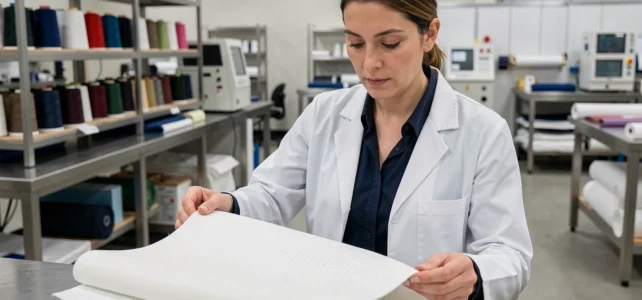
The Sécuridrap is a textile medical device for containment, primarily used in nursing homes, geriatrics, and hospital services. It aims to prevent nighttime falls in disoriented patients or those with low muscle tone, without resorting to rigid immobilization.
Textile containment and reduction of caregiver workload in facilities
In care facilities, managing patients at risk of falling requires a considerable amount of time. Care teams must monitor, intervene, and reposition patients, sometimes multiple times a night. This time, taken away from other care activities, impacts the overall organization of a service.
The Sécuridrap addresses this constraint through a textile approach. Rather than a system of mechanical barriers or traditional straps, it is a soft containment sheet that wraps around the patient in their bed. The fabric keeps the person lying down while allowing for partial freedom of movement (arms, head, torso rotation).
This principle of textile containment provides a direct advantage for caregivers: it reduces nighttime interventions related to unaccompanied attempts to get up. In a context where supply tensions on certain common care medications persist in France, non-drug preventive solutions are becoming increasingly relevant in the daily management of facilities.
Understanding the Sécuridrap innovation for comfort and safety involves this dual perspective: a patient benefit (fall prevention) and an organizational benefit (reduction of nighttime workload).
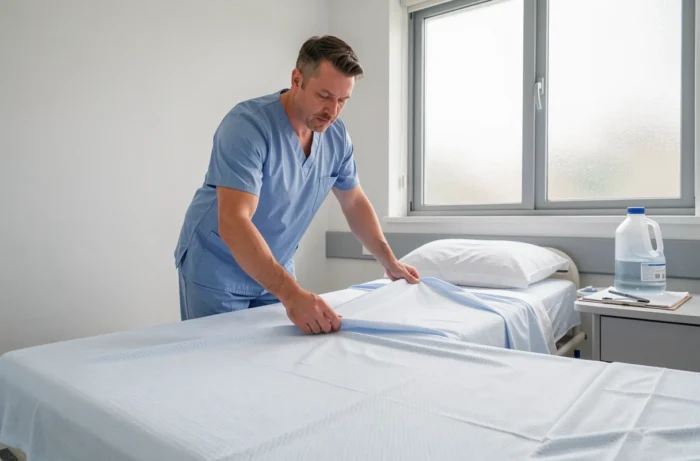
Sécuridrap Selfia fixation system: three anchor points
The latest generation of the device, marketed under the name Sécuridrap Selfia, is based on a three-point anchoring fixation system. This mechanism distinguishes the product from older containment sheets, which used simple side attachments.
The three anchor points distribute the tension exerted by the patient over several areas of the bed. The risk of fabric shear or detachment decreases compared to a two-point system. The locking mechanism is designed to prevent accidental opening by the patient while remaining quickly accessible to the caregiving staff.
What secure locking changes in practice
A disoriented patient attempting to get up exerts repeated, often asymmetrical pulls. With a simple locking mechanism, these pulls eventually create slack in the closure. The Selfia system uses a locking mechanism that withstands repeated pulls without requiring readjustment by the caregiver during the night.
The caregiver can open the device in a few seconds for a change, repositioning, or an emergency. The design thus incorporates two contradictory requirements: resistance to involuntary manipulations by the patient and ease of access for the care team.
Patient comfort and containment: reconciling two opposing requirements
Containment, in any form, raises a constant tension between safety and dignity. A device that is too restrictive causes agitation, anxiety, and sometimes skin lesions. A device that is too flexible does not protect against falls.
The Sécuridrap positions itself on this scale by using a textile that promotes calm and improves sleep quality, according to the manufacturer Mulliez-Flory. The fabric wraps without compressing. The patient retains the ability to move their arms, turn their head, and flex their legs within a limited range.
This approach is based on a principle known in geriatrics: the sensation of wrapping reduces agitation in certain disoriented patients. The continuous textile contact on the torso produces a containing effect comparable, in principle, to that of weighted blankets used in other contexts.
- The fabric is selected for its breathability, a crucial factor for bedridden patients who sweat more at night
- The cut of the sheet avoids compression folds at pressure points (sacrum, heels, shoulder blades)
- The Sécuridrap is compatible with industrial washing in hospital laundries, ensuring its durability in intensive use
Compliant medical device: regulatory framework of the Sécuridrap
The Sécuridrap is classified as a medical device, which subjects it to a precise regulatory framework. This classification is significant: it entails obligations for traceability, CE marking, and technical documentation that non-medical device classified containment sheets do not have to comply with.
For a healthcare facility, using a compliant medical device provides legal security in case of an incident. The traceability of the product, from its manufacturing batch to its assignment to the patient, is documented. In case of failure, the chain of responsibility is identifiable.
Prescription and usage framework
Containment, even textile, remains an act that must be prescribed and regularly reevaluated. The Sécuridrap is not used autonomously by a caregiver without prior medical prescription. This constraint, sometimes seen as a hindrance, protects both the patient and the facility.
- The prescription must specify the duration and conditions for reevaluation
- The device must be checked at each installation to ensure the proper positioning of the anchor points
- The condition of the textile (wear, tear, elasticity) is subject to periodic checks as part of the maintenance of medical devices
The ANSM maintains heightened vigilance regarding communication around health devices. Suspension decisions for advertising were made in 2026 for therapies whose regulatory compliance was not demonstrated. This context reinforces the interest in turning to devices with a clearly established regulatory status, such as the Sécuridrap.
The choice of a containment textile in a facility is not just a matter of comfort or practicality. It engages the responsibility of the facility, the quality of the patient’s sleep, and the organization of nighttime work. A correctly classified, prescribed, and maintained device remains the foundation of a containment that respects both the safety and dignity of the cared-for person.