
In Quimper, the median price of new properties reaches €4,346/m² in the third quarter of 2026, compared to around €2,188/m² for older properties. This simple doubling raises a direct question: is the extra cost of a new real estate program in Quimper justified by tax benefits, energy performance, and local rental demand?
Price per square meter in Quimper: new versus old in 2026
The PTZ barometer from Stop-loyer, published in September 2026, provides an accurate snapshot of the Quimper market. Here are the comparative data:
| Segment | Median price per m² | Recent evolution |
|---|---|---|
| New apartment | €4,346/m² | Stable (Q3 2026) |
| Old apartment | ~€2,150/m² | Almost stable over one year |
| Old house (overall median price) | €219,000 | +9.4% over one year |
The gap between new collective housing and old properties exceeds €2,000/m². For a 60 m² apartment, this represents an additional cost of around €130,000. This differential is the starting point for any decision: it must be weighed against energy savings, taxation, and the anticipated holding period.
Another notable data point: old houses have surged by nearly 10% in one year according to the Chamber of Notaries of the West, while old apartments remain stagnant. An investor targeting collective rental will therefore find an old market that is not very dynamic in price, which may limit the capital gain upon resale in this segment.
Choosing a new real estate program in Quimper means accepting a higher entry ticket by betting on builder guarantees, reduced notary fees, and a dedicated tax framework.

Jeanbrun scheme: what the 2026 finance law changes for new purchases in Quimper
Since January 2026, the Pinel scheme has been replaced by the Jeanbrun scheme, included in the 2026 finance law. Quimper is among the eligible municipalities, which directly alters the profitability calculation of a new rental investment in the city.
The mechanism relies on a tax reduction conditioned on a commitment to rent unfurnished for 9 years, with capped rents and tenant income limits.
- The tax reduction applies to the acquisition price of the new housing, within the limits set by decree.
- The owner must comply with rent ceilings adapted to the geographical area of Quimper, which frames the gross yield but secures occupancy.
For an investor, Quimper’s eligibility for Jeanbrun partially offsets the extra cost of new properties compared to old ones. However, the tax gain depends on the buyer’s tax bracket: the higher the marginal rate, the more significant the leverage.
Rental yield and demand in Quimper: concrete parameters
Beyond the purchase price and taxation, the viability of a new investment relies on the ability to rent quickly and sustainably. Quimper brings together several favorable factors for rental demand.
The city hosts around 5,000 students, a population that generates constant demand for small units (studios, T2). New programs offering this type of units with a balcony or terrace are positioned in a sought-after segment. Small new units capture recurring student and young professional demand.
The urban area exceeds 100,000 inhabitants, with a diverse economic fabric spanning agri-food, health, and services. This network limits dependence on a single employer and stabilizes the pool of potential tenants.
Reduced VAT and ancillary costs in new properties
A purchase in VEFA in certain development zones may entitle one to a reduced VAT rate, which lowers the cost price. Notary fees for new properties represent about 2 to 3% of the price, compared to 7 to 8% for older properties. On a €260,000 apartment, the savings on fees reach several thousand euros.
These expense items, rarely included in simplistic new/old comparisons, reduce the actual gap between the two segments. The price gap displayed per m² does not reflect the total acquisition cost.
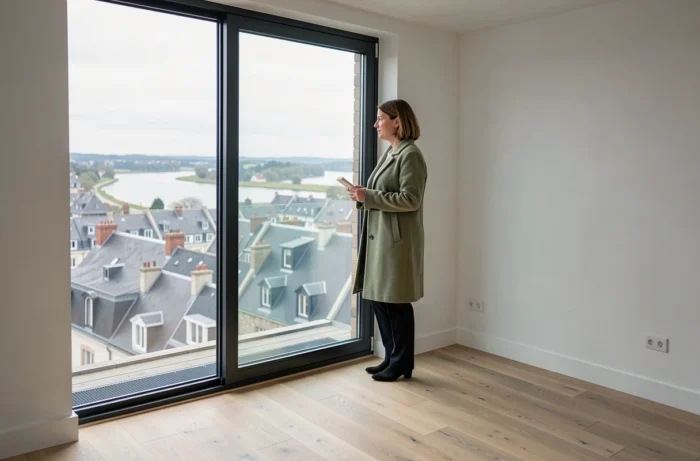
Renovated old or new in VEFA: arbitration based on the holding period
An investor planning to hold their property for less than ten years will find it difficult to benefit from new properties in Quimper. The initial extra cost takes time to be amortized by savings on charges, tax advantages, and the absence of work.
On a long holding period (fifteen years or more), the calculation reverses. A new property compliant with RE2020 standards generates energy costs that are much lower than those of an old apartment rated D or E on the energy performance certificate (DPE). The ten-year and two-year guarantees cover structural and equipment defects during the first years, eliminating the risk of unforeseen work.
The renovated old remains relevant for those seeking a higher immediate gross yield, thanks to a low entry price. However, the increasing constraints of the DPE on renting thermal sieves render some old properties unlettable without heavy renovations.
The planned holding period remains the determining criterion for arbitration between new and old in Quimper. Data from the third quarter of 2026 shows a market where new properties are expensive to purchase but secure long-term yield, while old properties offer quick access with a risk of depreciation linked to energy performance. The Jeanbrun scheme adds a tax lever that favors new properties for the most heavily taxed taxpayers.