Quartz concrete combines high mechanical resistance and a smooth finish that appeals in both industrial and residential settings. However, this layer of quartz sprinkled on the surface, while hardening the slab, introduces technical constraints that product data sheets often overlook. Here, we detail the concrete weaknesses to assess before validating this flooring choice.
Crystalline silica dust: health risks during renovations
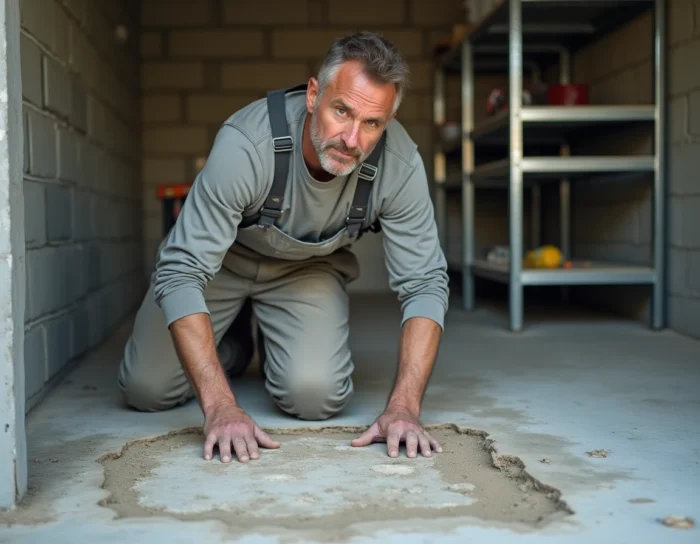
Quartz is a mineral silicate rated 7 out of 10 on the Mohs scale. This hardness, marketed as an advantage, becomes a serious issue when reworking the slab. Sawing, sanding, grinding, chiseling, or drilling grooves: each operation on the quartz layer releases a fraction of alveolar respirable crystalline silica dust, fine enough to reach the pulmonary alveoli.
A standard concrete already generates cement dust during these interventions. Quartz concrete exacerbates the problem because the wear layer concentrates quartz on the surface, exactly where tools attack the material. Repeated exposure to this dust can cause silicosis and increases the risk of lung cancer.
We have listed the disadvantages of quartz concrete on Eco Habitat, and this health aspect is rarely mentioned in consumer guides, even though it conditions the complete site protocol: source extraction, wearing respiratory PPE, watering cutting areas.
Cracking of quartz concrete: shrinkage joints and curing conditions
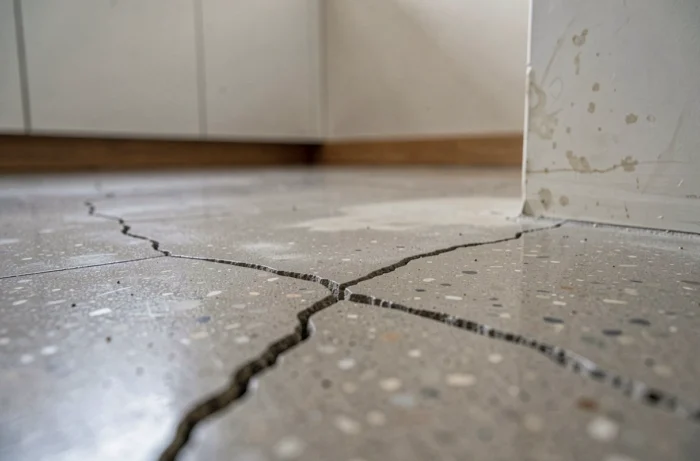
Quartz concrete cracks just like standard concrete if the joint layout is poorly designed. The quartz layer does not compensate for either hydraulic shrinkage or thermal shrinkage of the slab. It stiffens the surface, making microcracks more visible and harder to repair than with raw or waxed concrete.
Mechanical surfacing (trowel, helicopter) closes the surface pores and creates a dense film. If curing is not applied immediately after troweling, differential evaporation between the hardened surface and the core of the slab causes superficial crazing. This network of microcracks does not compromise the structure but ruins the smooth and shiny appearance that motivated the choice of quartz.
The most common implementation errors
- Sprinkling quartz on concrete that has not finished bleeding, trapping water under the hardened layer and causing plate delaminations
- Absence of expansion joints every few meters, leading to uncontrolled through cracks
- Application of a curing product incompatible with the planned finishing treatment (varnish, resin), preventing the adhesion of the protective coating
These defects are irreversible. Unlike waxed concrete, which can be resurfaced with a thin layer, cracked quartz concrete often requires planing or complete leveling.
Stain sensitivity and maintenance of quartz flooring
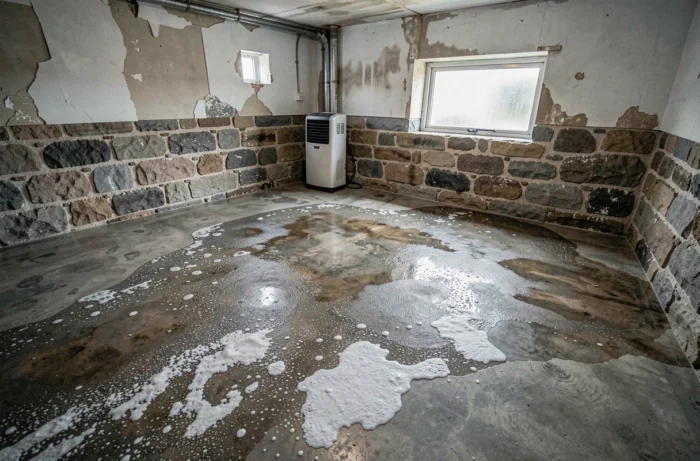
The surface of quartz concrete is dense, but it remains porous. Without the application of a varnish or water repellent, fats, acids, and dyes penetrate the first tenths of a millimeter and leave lasting marks on the floor. In kitchens or garages, this residual porosity turns every spill into a potentially permanent stain.
We often observe confusion between hardness and impermeability. Quartz protects against mechanical abrasion, not against chemical attacks. A simple lemon juice left for a few minutes can attack the cement matrix around the quartz grains and create a dull halo on a shiny finish.
Chemical protection: two products, not one
Complete protection of a quartz floor requires two distinct treatments. The concrete curing applied immediately after pouring limits shrinkage and crazing. The protective varnish (polyurethane or epoxy), applied after the slab has completely dried, ensures chemical waterproofing.
Omitting either one compromises durability. Curing alone does not protect against stains. Varnish alone, applied to a poorly cured slab, peels off due to residual moisture rising. This double treatment increases the budget and extends the time before commissioning.
Regulations on crystalline silica and site constraints
Respirable crystalline silica is subject to increasingly strict regulatory oversight in Europe. Any subsequent intervention on a quartz floor (core drilling for network passage, leveling, partial demolition) subjects the project owner to prevention obligations related to exposure to silica dust.
In practice, this means that modification work on quartz concrete costs more than an equivalent intervention on a soft floor or tiles. Source extraction, dust monitoring, and specific PPE represent an additional cost that no one anticipates at the time of the initial flooring choice.
For public-access premises or buildings subject to prevention plans, this constraint can make quartz concrete less relevant than a removable or sawable flooring without silica emissions.
Quartz concrete or waxed concrete: the limits of a quick comparison
Waxed concrete and quartz concrete share a common ancestor (industrial floors from the 80s), but their weaknesses diverge. Waxed, applied in a thin layer, better tolerates movements of the substrate and can be repaired locally. Quartz, bonded to the slab, offers superior mechanical resistance, but any localized repair remains visible because the color and grain size of the quartz vary from batch to batch.
No invisible joint is possible on damaged quartz concrete. This is a structural limitation of the material, not a defect in installation. On an industrial floor, this heterogeneity goes unnoticed. In a living room or kitchen, it sometimes necessitates redoing the entire surface.
Quartz concrete remains a high-performance flooring option for areas subjected to heavy traffic, provided that joint constraints, chemical protection, and silica dust management are integrated from the design stage. Ignoring these parameters turns a durable floor into a source of costly repairs and technical disputes on site.