
We start the mower for the first spring cut, and after twenty minutes the tank has already dropped by a third. The reflex is to suspect a leak. In most cases, the problem comes from the engine itself: an unbalanced air-fuel mixture, clogged parts, or degraded gasoline are enough to dramatically increase the consumption of a gas mower.
Entry-level engine and structural gasoline overconsumption
Before looking for a malfunction, we can ask a more direct question: what engine powers your mower? An engine like the Loncin 196 cc, common in consumer models, shows an average consumption of about 1.8 liters of unleaded gasoline per hour, with a tank of about 3.6 liters. At this rate, two hours of sustained mowing will empty the tank.
Higher-end engines (Honda GX200, equivalent Briggs & Stratton) consume less for comparable power. This helps explain why, when exploring the reasons for high gas consumption in gas mowers, the choice of engine rarely tops the list even though it weighs heavily in the equation.
In other words, an entry-level engine structurally consumes more. Maintenance can limit the excess but cannot erase the design gap. If your mower has always seemed thirsty, the engine may be to blame rather than a failure.
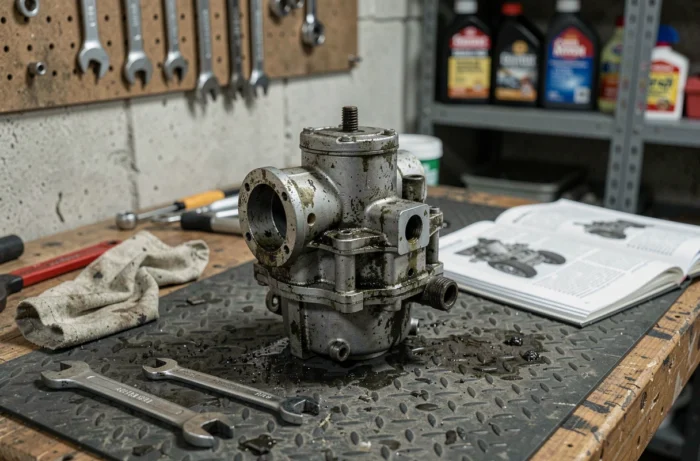
Clogged carburetor: the air-fuel mixture adjustment that goes wrong
On the ground, the carburetor is the part that causes the most consumption problems. Its role is to precisely dose the air and fuel before admission into the engine. When it gets clogged, this dosing deteriorates.
How a carburetor causes excess fuel
Residues of aged gasoline, particles drawn in, or condensation form a deposit on the jets and internal membranes. The airflow is reduced, the mixture becomes richer, and the engine receives more fuel than it burns. The signs that accompany this imbalance include:
- The engine coughs or stalls when accelerating, then resumes at a stabilized speed
- Black or dark gray smoke comes out of the exhaust, a typical sign of incomplete combustion
- The idle becomes unstable, the engine hesitates between two speeds
- The smell of raw gasoline is noticeable around the mower during mowing
A poorly adjusted carburetor can significantly increase consumption. The mixture screws allow for adjusting the air-fuel dosing. On many consumer mowers, these screws are accessible without heavy disassembly. A quarter turn is sometimes enough to restore normal operation.
Stuck choke in the closed position
The choke (or starting flap) intentionally enriches the mixture to facilitate cold starting. If it remains engaged once the engine is warm, the mower runs continuously with excess fuel. It’s easy to forget to push it back, and on some models, the control cable can seize over time.
Check the position of the choke after two or three minutes of operation. If it is still closed, it is a direct source of overconsumption.
Degraded gasoline in the tank: a fuel that no longer burns properly
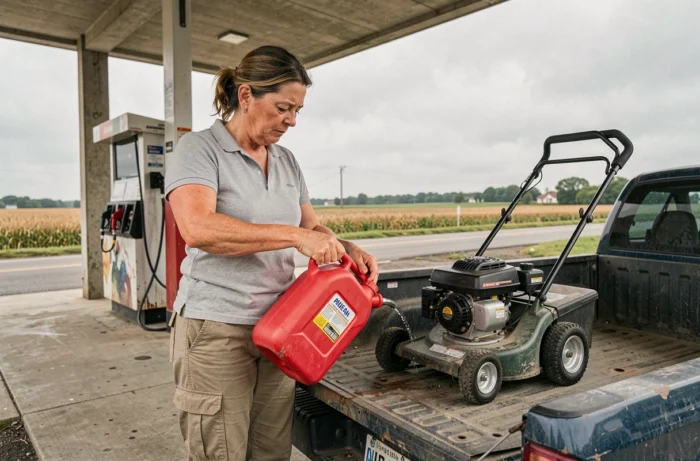
Gasoline is often left in the tank between seasons. After a few weeks without use, the fuel begins to degrade. The lighter compounds evaporate, leaving a heavier and less volatile liquid that burns poorly in the engine.
Degraded gasoline clogs the carburetor and reduces combustion quality. The engine compensates by consuming more to maintain its speed. Difficult starts and irregular operation are also observed.
To avoid this problem, the most reliable practice is to drain the tank before winter storage. Running the engine until it stalls helps evacuate the residues in the fuel system. If you store gasoline in a can, do not keep the same fuel from one season to the next.
Air filter and tank cap: two neglected parts that cost dearly in fuel
The air filter and tank cap are rarely suspected first. However, they play a direct role in consumption.
Clogged air filter and air-fuel ratio
A clogged air filter reduces the volume of air entering the engine. To compensate, the carburetor allows proportionally more gasoline to pass through. The mixture becomes too rich, and combustion loses efficiency.
In real conditions, a filter that has worked all season in dusty grass is often saturated. Cleaning or replacing the air filter immediately restores the correct air-fuel ratio. For a foam filter, washing it with soapy water followed by complete drying is sufficient. Paper filters need to be replaced.
Tank cap and venting
The tank cap has a small vent that allows air to enter as the gasoline level drops. If this vent is blocked by debris or dirt, a vacuum forms in the tank. The fuel reaches the carburetor irregularly, causing the engine to work harder and consume more.
The test is simple: if the engine stalls after a few minutes and restarts when you unscrew the cap, it is the vent that is at fault. Cleaning with a needle or replacing the cap solves the problem.
Worn spark plug and its impact on consumption
The spark plug produces the spark that ignites the combustion. When it wears out, the electrode erodes, the gap changes, and the spark weakens. The fuel no longer burns completely in each cycle, forcing the engine to consume more to provide the same power.
The symptoms of a tired spark plug overlap with those of other failures:
- Difficult starting even when warm, requiring several attempts
- Occasional misfires, the engine “stutters” during mowing
- Black and oily deposit on the electrode when removing the spark plug
Replacing the spark plug each season is the simplest and least expensive maintenance to maintain effective combustion. The change takes less than five minutes with a suitable spark plug wrench.
A gas mower that consumes too much almost always sends a clear signal: smoke, unstable idle, difficult starting. The right approach is to check the elements in order of simplicity, from the air filter to the spark plug, including the quality of the gasoline and the carburetor adjustment. Each corrected part brings the engine closer to its normal consumption and extends the machine’s lifespan.