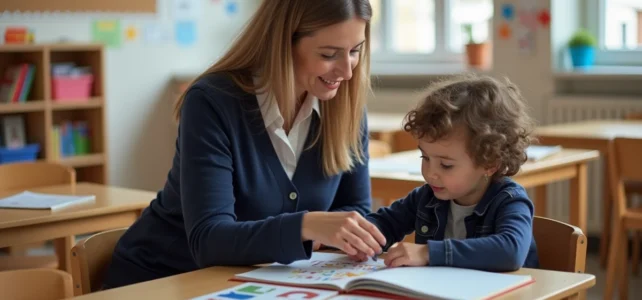
The French education system organizes compulsory schooling into three multi-year cycles, each covering several grade levels. For a parent, the numbering “cycle 1, cycle 2, cycle 3” often remains vague, reduced to administrative jargon. Comparing what each cycle encompasses in terms of duration, concerned classes, and educational objectives allows for a better understanding of a child’s educational journey.
Comparative table of cycles 1, 2, and 3: classes, duration, and objectives
| Cycle | Official Name | Concerned Classes | Duration | Main Objective |
|---|---|---|---|---|
| Cycle 1 | Cycle of Early Learning | Petite, moyenne, and grande sections of kindergarten | 3 years (from 3 to 6 years) | Foster a desire to learn, develop oral language, introduce basic mathematical concepts |
| Cycle 2 | Cycle of Fundamental Learning | CP, CE1, CE2 | 3 years (from 6 to 9 years) | Master reading, writing, and arithmetic |
| Cycle 3 | Cycle of Consolidation | CM1, CM2, 6th grade | 3 years (from 9 to 12 years) | Consolidate knowledge, prepare for autonomy in middle school |
One point often escapes families: cycle 3 overlaps elementary school and middle school. The 6th grade is an integral part of the consolidation cycle, meaning that the programs for CM1, CM2, and 6th grade form a continuum. This choice, stemming from the law on the reform of the School, aims to smooth the transition between primary and secondary education.
To delve deeper into cycles 1, 2, and 3 in school, it is also necessary to look at recent regulatory texts, as the framework has significantly changed since 2024.
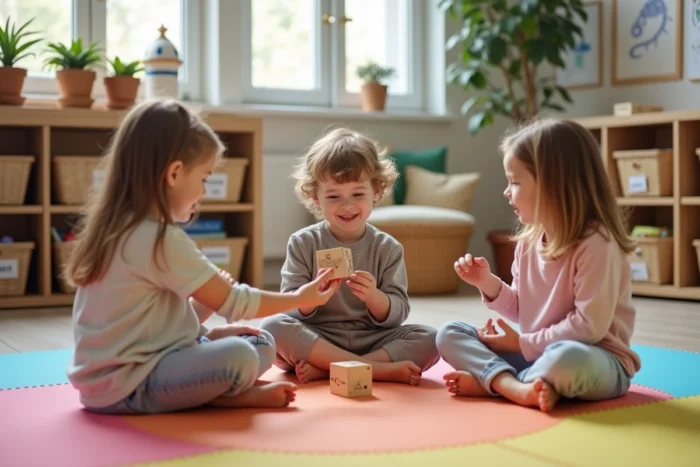
Cycle 1: What changes with the new programs 2025-2026
Cycle 1 has long operated based on the decree of February 18, 2015. This text set five areas of learning for kindergarten. Since then, two regulatory developments have followed.
The first: new programs for French and mathematics, published in Official Bulletin No. 41 of October 31, 2024, with more explicit expectations and a better-defined progression throughout the cycle. The stated goal is to prepare for entry into CP more clearly.
The second: a decree of April 16, 2026, published in the Official Bulletin of May 7, 2026, which replaces the 2015 decree. This overhaul introduces six areas of learning instead of five. The framework of cycle 1 has thus been profoundly redefined in less than two years.
For parents, the direct consequence is that report cards and assessed competencies in kindergarten are evolving. A child entering petite section in the 2026 school year will not follow exactly the same program as their older sibling who entered three years earlier.
Cycle 2 and Cycle 3: Where the Real Educational Gaps Are
Cycle 2 focuses on acquiring reading, writing, and basic arithmetic skills. The entire cycle (CP, CE1, CE2) is based on a principle of progression: a student who has not consolidated their reading in CP has two additional years within the same cycle to achieve this, without it being considered a “delay” in the strict sense.
In contrast, cycle 3 introduces a change in logic. The student transitions from learning basic skills to applying them in more complex contexts. The science and technology curriculum, for example, covers CM1, CM2, and 6th grade as a single block, with common objectives.
6th Grade: A Often Misunderstood Link
Many parents view the transition to 6th grade as a break. The division into cycles tells a different story: 6th grade extends the work of elementary school. The teachers of CM2 and 6th grade are supposed to coordinate their progressions. In practice, this coordination depends on the school-college councils established locally.
This structure also explains why repeating a year between CM2 and 6th grade has become rare. The transition occurs within the same cycle, not between two distinct cycles.
Duration of Cycles and Progression Logic: What Parents Can Take Away
The choice of three-year cycles is not arbitrary. It is based on the idea that children do not acquire skills at the same pace, and that a multi-year framework allows time to consolidate before moving on to the next step.
- In cycle 1, a child who speaks little in petite section has two additional years to develop their oral language before CP, without pressure of “level.”
- In cycle 2, reading can stabilize over three years. A student who decodes slowly in CP is not failing as long as they are making progress within the cycle.
- In cycle 3, the school-to-college transition is designed to prevent dropouts: the expectations at the end of 6th grade are those for the end of cycle 3, not an isolated milestone.
This logic has a downside. National assessments (beginning of CP, beginning of CE1, beginning of 6th grade) measure achievements at specific points, which do not always coincide with the ends of cycles. A child assessed at the beginning of CP is tested on the achievements of cycle 1, not on those of cycle 2 that they are just beginning.
The school programs clearly distinguish what belongs to each cycle, but classroom practices vary from one institution to another. A parent who understands the structure of the cycles can better interpret report cards, identify at what stage of progression their child is, and ask more precise questions to teachers. The division into three three-year cycles remains the skeleton of the system, even when the programs that dress it change.