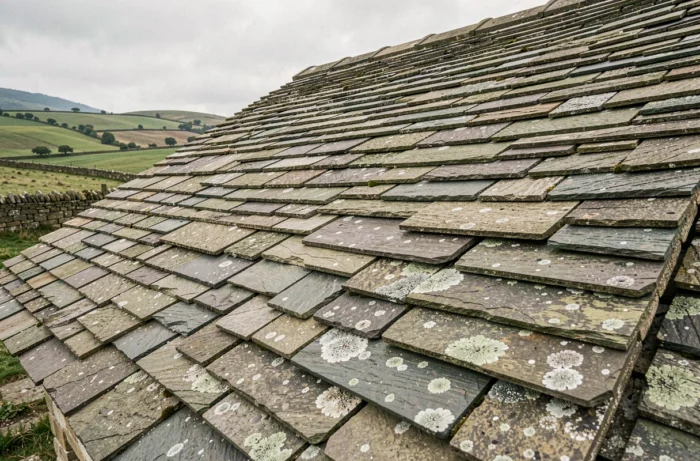
What really distinguishes a slate roof from a traditional covering in terms of thermal performance, durability, and regulatory constraints? This question deserves to be asked with concrete data, as roofs covered with flat stones are not just part of the visual heritage. Their presence in several regions of France is based on measurable physical properties and a legal framework that has evolved recently.
Calcareous slates and schist slates: compared properties of roofing materials
The term “slate” encompasses distinct geological realities depending on the regions. In Burgundy, slates are limestone slabs. In the Cévennes or Lozère, slates are schistous. This difference in nature directly conditions the behavior of the roof.
| Criterion | Limestone slate (Burgundy, Périgord) | Schist slate (Cévennes, Aveyron) | Terracotta tile |
|---|---|---|---|
| Weight per m² | Very high | High | Moderate |
| Thermal inertia | Strong | Strong | Low to medium |
| Estimated lifespan | Several generations | Several generations | Several decades |
| Minimum slope required | Variable depending on thickness | Generally steep | Moderate |
| Framework | Reinforced mandatory | Reinforced mandatory | Standard |
| Repairability | Partial repair possible | Partial repair possible | Unit replacement |
Thermal inertia is the least visible but most significant advantage. A flat stone covering accumulates heat during the day and gradually releases it, which naturally regulates the temperature under the eaves.
A detailed article on flat stone roofs on La Gazette d’Hector explores the historical and practical reasons for this roofing choice in the French limestone regions.
Slate roofing and insulation: what energy rehabilitation of heritage buildings changes
The central question for owners of flat stone roofs is not whether the slate is beautiful. It is how to insulate it without destroying it.
The energy rehabilitation guide for heritage buildings published by the Ministry of Culture addresses this point. Interior insulation remains the only viable option on a slate roof, as any external intervention would alter the protected appearance of the roof.
This constraint has direct consequences on the usable area of the attic. Installing insulation under the framework reduces the interior volume, and the reinforced framework (necessary to support the weight of the stones) sometimes complicates the installation of standard panels. Specialized craftsmen often proceed by blowing in or applying soft materials between the wooden pieces.
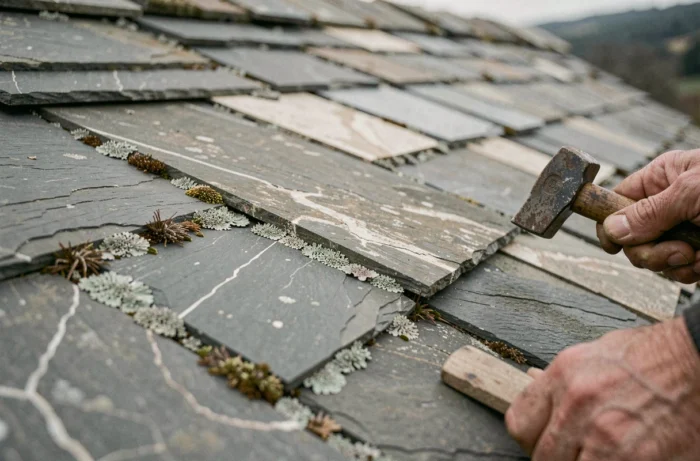
Partial repair rather than total renovation
Feedback from recent projects, particularly on restorations in Lozère, confirms a technical point often overlooked: a slate roof is repaired through partial repair. Broken or displaced pieces are replaced individually, and weak points are addressed without dismantling the entire structure.
This “rechargeable” maintenance mode changes the long-term economic calculation. The initial construction costs significantly more than a tile covering, but maintenance interventions remain localized and do not require replacing the entire roof.
PLU and roofing materials: what recent case law says
Local urban planning documents frequently mandate slate in protected areas or mountainous zones. The minimum slope, roofing material, and sometimes the color are prescribed by the Local Urban Plan.
A decision by the Council of State on July 13, 2026, provided notable clarification. A PLU can only impose a roofing material if this requirement is genuinely necessary to achieve the desired heritage objective. The mere invocation of landscape protection is no longer sufficient if a less restrictive solution can produce an equivalent result.
In practice, this means that owners engaged in renovations can, in some cases, propose alternatives (reconstituted slates, for example) if the visual result and durability are comparable. Dialogue with the building permit review service becomes a lever, where the obligation was previously perceived as absolute.
Mountain areas: reinforced but framed prescriptions
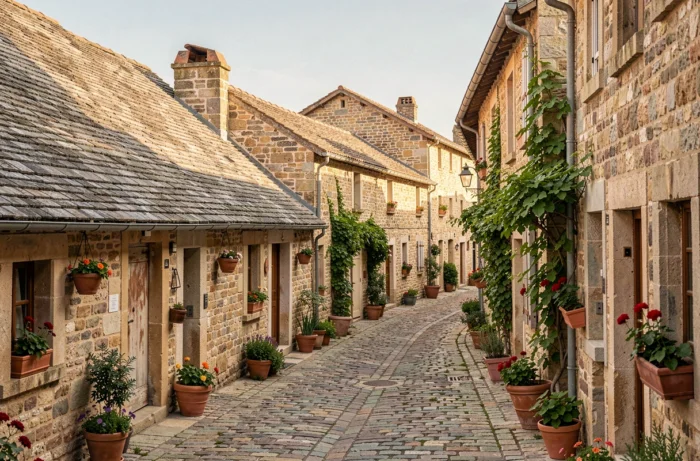
Urban planning documents in mountainous areas impose minimum slopes and traditional materials. These prescriptions confirm that slate remains a standard material in certain sectors, not just an aesthetic choice. There is room for maneuver, but it is negotiated case by case, with documented technical arguments.
French regions and flat stones: where these roofs still exist in France
The geographical distribution of flat stone roofs logically follows geological outcrops. Wherever limestone or schist is accessible at the surface, traditions of slate roofing have developed.
- Burgundy uses “laves,” limestone slabs laid in decreasing rows from the bottom to the ridge, with thicker pieces at the bottom to support the load
- Périgord and Quercy use thinner limestone slates, suited to slopes often less steep than those in Burgundy
- The Cévennes and Aveyron work with schist, using lighter slates but a different installation technique, adapted to the material’s fissility
- Savoie and Haute-Savoie use gneiss or micaschist slates, laid on massive frameworks designed for snow loads
In each of these regions, the local term differs. “Laves” in Burgundy, “lauzes” in the South, “thick slates” in some alpine areas. The vocabulary changes but the constructive logic remains the same: to exploit the local stone for sustainable building coverage.
Flat stone roofs endure through the centuries because they meet a simple equation: a local material, a mass that stabilizes the covering against the wind, and a repairability that avoids complete replacement. Recent case law requires rethinking regulatory obligations as negotiable frameworks, opening the way for better-insulated renovations without giving up slate.