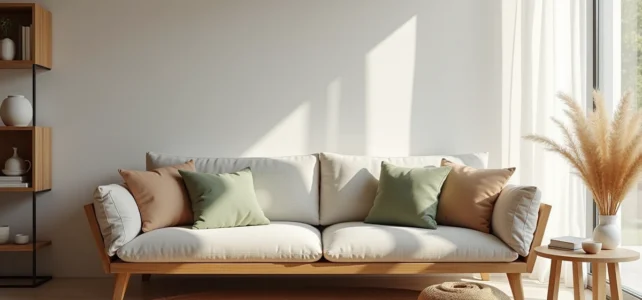
Adopting a decor trend when you already live in your home, with your furniture, natural light (or lack thereof), and the constraints of daily life, poses a problem that magazines rarely address. Which decor ideas for 2026 withstand the transition from catalog to the reality of a lived-in interior? The answer depends less on the chosen style than on the method of integration.
Adapting a 2026 decor trend when the interior is already furnished
Most decor content showcases empty or completely rearranged spaces. This approach overlooks the main constraint: a living room already occupied by a sofa, a table, toys, and a north-facing exposure that cuts off half of the light effects photographed on Pinterest.
The most realistic approach is to progress in layers rather than redo the entire room. Start with textiles (cushions, curtains, throws), then accessories (lighting, objects, frames), and only then the furniture if the budget allows. This layered logic allows you to test an aesthetic direction without heavy financial commitment.
Among the decor resources on Ma Maison Info, several articles detail this method applied to common living spaces.
With children, the filtering criterion is simple: anything that easily gets dirty or breaks when falling from the coffee table is automatically eliminated. Trends that focus on washable materials and rounded shapes pass this filter. The others will wait for the siblings to grow up.
Colored ceilings and graphic floors: surface decor trends for 2026
One of the most striking directions for 2026 concerns surfaces that have long been ignored by mainstream decor. Ceilings and floors are becoming decorative surfaces in their own right, with ceilings painted in deep shades, textured or enhanced with moldings, and floors featuring more graphic patterns.
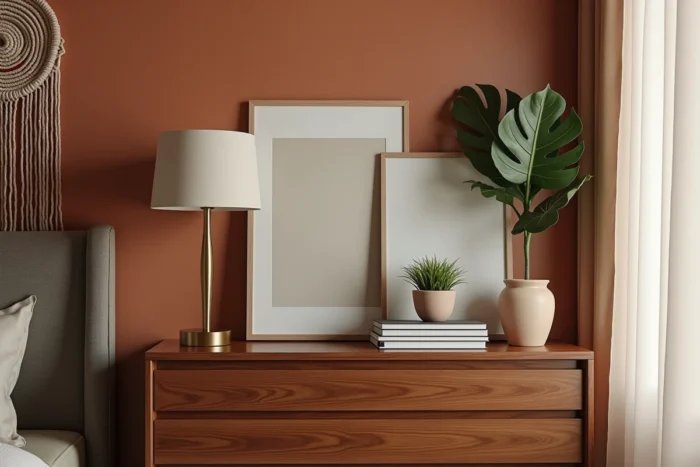
This trend works particularly well in small homes. A colored ceiling draws the eye upward and gives an impression of volume that classic white walls do not produce. For a narrow hallway or a studio, it’s a cost-effective lever.
Constraints to anticipate before painting a ceiling
The ceiling height conditions everything. Below 2.40 m, a dark shade risks overwhelming the room. Above, the effect gains depth.
- Natural light determines the result: a north-facing room requires warm shades (terracotta, ochre) to compensate for the coldness, while a south-facing exposure tolerates cool colors (deep blue, forest green)
- A painted ceiling requires more neutral walls to avoid visual saturation, especially in a space of less than 20 m²
- Matte finishes hide surface imperfections, whereas satin reveals every irregularity, a point to check before starting
Natural materials and deep colors: the budget and maintenance filter
Dark wood (walnut at the forefront), organic shapes, and burgundy or mocha palettes dominate the decor projections for 2026. Translated into concrete choices for a lived-in interior, this provides a useful comparison chart.
| Trend | Entry Cost | Maintenance | Child-Friendly |
|---|---|---|---|
| Solid walnut (main furniture) | High | Medium (regular oil) | Yes (shock-resistant) |
| Burgundy/mocha palette (wall paint) | Low | Low | Yes (dark shades hide marks) |
| Curved shapes (designer furniture) | Variable | Low | Yes (no sharp edges) |
| Wall tiles (kitchen/bathroom) | Medium | Very low | Yes |
| Chrome touches (lighting, handles) | Low to medium | Medium (fingerprints) | No (fragile, dirty) |
Reading this table reveals a often overlooked point: the cheapest trends to adopt are also the most compatible with family life. Repainting a wall in burgundy costs the price of a can of paint and withstands marks better than an off-white. In contrast, chrome accessories, highly photographed on social media, combine fragility and maintenance.
Slow decor: decorate less but better
The slow decor movement, which has been gaining momentum since 2025, proposes to limit the number of decorative objects to prioritize durable and chosen pieces. In practical terms, this means replacing an accumulation of small accessories with one or two higher-quality elements.
For an already cluttered living room, this approach works like decluttering: remove before adding. A handcrafted ceramic vase placed on a cleared shelf makes more of an impact than a dozen knick-knacks scattered across every available surface.
Pantone Color 2025 Mocha Mousse: integration into an existing interior
The Mocha Mousse shade, designated color of the year by Pantone, appears in many furniture and textile collections. Its advantage for an already furnished interior: mocha pairs well with most light woods and neutral tones already present in French homes.
A gray sofa, omnipresent in living rooms, pairs seamlessly with mocha cushions and a throw in the same range. For a bedroom, bedding in this shade warms the atmosphere without needing to repaint.
Conversely, this color loses its readability in a room already saturated with warm tones (yellow walls, honey-colored flooring, beige curtains). In this case, it blends into the decor instead of renewing it. It’s better to opt for a contrast, such as a deep blue or sage green.
The choice of a decor trend is not measured by its popularity on social media, but by its ability to function in the real conditions of a home. Testing in layers, filtering by daily use, and respecting the natural light of each room remains the most reliable method to avoid costly mistakes.