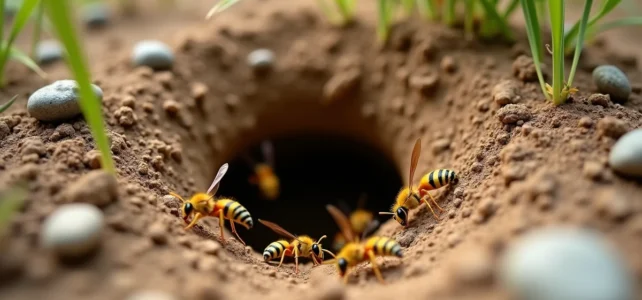
Ground wasps refer to several species of social wasps (mainly Vespula germanica and Vespula vulgaris) that establish their colony in underground cavities. Their nest, often invisible from the surface, is betrayed by a simple hole in the ground and a regular coming and going of insects at lawn level. Discovering this type of nest poses a concrete safety issue, especially in a frequented garden.
Frequent confusion between ground wasp nests and underground hornet nests
A discreet hole at ground level with insects entering and exiting does not automatically mean it is wasps. Field reports from pest control professionals show an increase in confusion between underground wasp nests and hornet nests located underground. Both have a similar entrance, but the danger is significantly greater for hornets, due to the size of the colony and the aggressiveness of disturbed individuals.
Observation should be done from a distance, ideally several meters back. The size of the insect provides a first clue: a common wasp measures about 1.5 cm, while a European hornet exceeds 2 cm. The Asian hornet, stockier and with yellow legs, can also nest lower down. In case of doubt, the systematic recommendation from certified operators is to avoid approaching and to request a professional diagnosis.
Knowing what to do in case of ground wasps starts with this identification step, without which any intervention risks being inappropriate or dangerous.
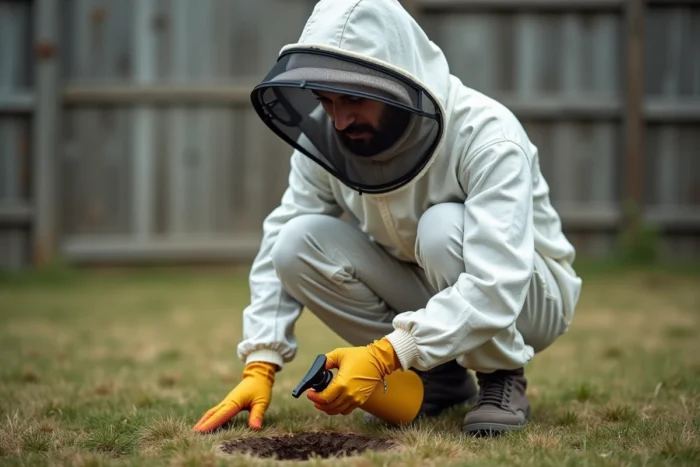
Improvised methods on a ground wasp nest: why they worsen the situation
Blocking the hole with soil, pouring boiling water, using gasoline, or attempting to burn the entrance of the nest are among the most common reflexes. These methods are also the most counterproductive.
An underground wasp nest consists of galleries that sometimes extend several tens of centimeters below the surface. Blocking the main entrance does not eliminate the colony: the wasps find or dig a secondary exit, often closer to a passage area. They then become significantly more aggressive.
- Boiling water only reaches the first galleries and triggers an immediate defensive reaction from the colony, with a risk of multiple stings.
- Gasoline or any chemical solvent pollutes the soil and surface waters without guaranteeing the elimination of the nest.
- Fire near a hole in a dry lawn poses a fire risk, in addition to only partially destroying the structure.
- Blocking the hole (with soil, cement, expanding foam) traps the wasps inside, who then seek another exit, sometimes towards the interior of a home.
Since the widespread implementation of Certibiocide in France, specialized companies remind that the use of professional insecticides is reserved for holders of this certification. Over-the-counter products (consumer aerosols) have insufficient reach and residual effect to treat a buried nest.
Three conditions to consider an intervention without a professional
Recent practical guides converge on one point: an intervention on a small ground nest is only feasible if three conditions are met simultaneously. The absence of even one of them makes the operation too risky for an individual.
First condition: the nest must be isolated, meaning located far from any frequently trafficked area (terrace, playground, house entrance). Second condition: access to the hole must be direct, on stable ground, without requiring a ladder or unstable positioning. Third condition: no person allergic to wasp stings should live or regularly stay in the household.
If these three criteria are met and the nest is still small (early in the season, low activity), a treatment at dusk with an approved powder insecticide, applied at the entrance of the hole, may suffice. Wasps are less active and less reactive at this time. Wearing covering clothing, thick gloves, and a protective veil remains essential.
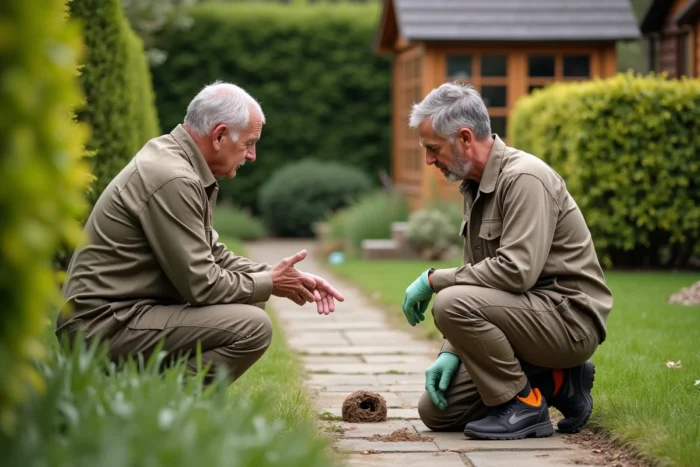
Safety perimeter and professional intervention on an underground nest
When the nest is near a playground, school, or communal space, pest control professionals refuse any intervention in “public mode.” The standard procedure is to establish a safety perimeter of 3 to 5 meters around the entrance of the nest, using tape or markers, while waiting for the operator to arrive.
This perimeter is not an excessive precaution. A disturbed ground wasp colony can mobilize several hundred individuals in a matter of seconds. Children, who run and create vibrations in the ground, are the first exposed.
Process of a professional intervention
The certified operator begins by identifying the species and assessing the size of the colony. The treatment generally relies on a residual effect insecticide powder injected directly into the galleries, sometimes supplemented by a professional aerosol. The entrance of the nest is then monitored for a few days to confirm complete elimination.
The cost of an intervention varies depending on the location of the nest and the accessibility of the terrain. In France, some municipalities or community groups cover all or part of the treatment, especially when the nest is located in public space or in immediate proximity. Checking with the local authority before directly contacting a company can sometimes avoid costs.
Ground wasps and ecological role: should the nest always be destroyed?
Wasps, including ground species, are active predators of flies, caterpillars, and aphids. A colony established in a remote corner of the garden, away from living areas, contributes to the natural regulation of harmful insects to crops.
A nest that poses no direct danger does not necessarily require destruction. The colony dies naturally in the autumn with the first frosts. Only the young fertilized queens survive by hibernating elsewhere, and they never reuse the old nest the following year.
The decision to destroy or coexist therefore entirely depends on the location. A nest under a frequented terrace necessitates a quick intervention. A nest at the back of an unkempt yard can be left in place until the end of the season, provided it is signaled to those who might approach it.