
You have probably encountered someone wearing their watch with the dial facing the inside of their wrist. The gesture surprises and sometimes intrigues. Wearing a watch upside down is neither an oversight nor a gratuitous eccentricity: this habit is based on very concrete reasons related to profession, comfort, or the value of the object.
Watch worn with the dial facing inward: a reflex born in the field
The origin of this gesture is not found in fashion, but in professional contexts where checking the time needs to remain discreet or quick. Military personnel, nurses, and divers were among the first to turn their watches around.
A soldier in a shooting position needs to read the time without raising their wrist or exposing a bright reflection. The dial facing inward eliminates distracting reflections that could reveal a position. The same principle applies to law enforcement during nighttime interventions.
In the medical field, the logic differs. A nurse taking a pulse keeps their fingers on the patient’s artery and slightly turns their own wrist to read the seconds. The dial oriented inward makes this movement more natural, without letting go of the patient’s hand.
These professional uses explain why the habit has spread well beyond barracks and hospitals. Many people who wear their watch upside down replicate a gesture learned from a parent or colleague, often without knowing its military or medical origin. To delve deeper into the meaning of an inverted watch on Have a Fashion Break, the topic is explored from a cultural and historical perspective.

Protecting a luxury watch by wearing it upside down
With the marked increase in prices in watchmaking in recent years, owners of expensive watches are adopting increasingly cautious behaviors. Wearing the dial facing inward is part of these preservation reflexes.
Crystal and bezel: the most exposed areas
On a classic watch worn with the dial facing outward, the crystal (the glass) and the bezel take the brunt of everyday shocks: bumps against a desk, a doorknob, a wall. Turning the dial protects the crystal from micro-scratches and direct impacts.
This reflex makes perfect sense for vintage pieces whose glass is made of plexiglass, a softer material than modern sapphire. A collector wearing a watch from the 1960s on their wrist has every reason to turn the dial inward to avoid degrading a component that is difficult to replace.
Luxury watches and risk perception
The luxury watch market is experiencing sustained growth, driven by the perception of the watch as a status symbol. This upgrade in quality comes with increased attention to the preservation of the object. The more expensive a watch is, the more its owner seeks to limit daily risks.
Some watchmakers and retailers report that customers spontaneously wear the dial facing inward as soon as they purchase a high-end piece. The gesture is not superstitious: it is a rational calculation to preserve resale value.
Comfort and ergonomics: when wearing a watch upside down makes daily life easier
Beyond protection, wearing the watch upside down addresses an ergonomic issue that many wearers encounter without clearly articulating it.
- The crown, located on the right side of most watches, can press against the back of the hand when the wrist is bent. Turning the watch moves the crown inward on the arm, which eliminates the pressure point on the bending wrist.
- People who work long hours at a keyboard often find the outer dial bothersome: the case rubs against the desk or catches the edge of the laptop. Wearing it upside down eliminates this friction.
- For athletes, the turned watch remains more stable on the wrist during sudden movements, and the dial is less likely to hit equipment or an opponent.
Comfort is probably the most common reason among wearers who have no connection to the military or medical field. The gesture arises from repeated discomfort, not from an aesthetic choice.
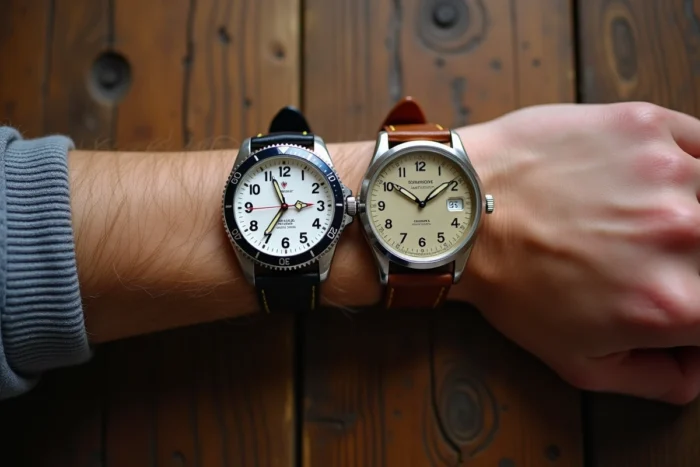
Symbolism and social codes of wearing an inverted watch
Wearing a watch upside down also conveys messages, sometimes involuntary. In certain professional circles, the gesture signals familiarity with fieldwork. An executive wearing their watch dial inward during a meeting may, consciously or not, evoke a military past or a culture of pragmatism.
The aspect of “discretion” also plays a social role. Checking the time without showing the dial avoids ostentatiously displaying an expensive watch. In contexts where flaunting wealth is frowned upon, wearing it upside down serves as a code of restraint.
Conversely, some see it as a sign of nonconformity. Wearing a familiar object in an unusual way attracts attention and sparks conversation. The upside-down watch then becomes a marker of personality, a way to stand out without additional accessories.
Family tradition and imitation
Many inverted wearers do not theorize their choice. They replicate the gesture of a father, grandfather, or instructor. The transmission occurs through imitation, and the original reason (military, medical, professional) sometimes gets lost in a generation. The gesture survives, detached from its initial function, driven by habit and emotional attachment.
Wearing a watch upside down remains a minority practice, but its motivations are more varied than they appear. Protecting a valuable object, daily comfort, social discretion, or simple family heritage: each wrist tells a different story. The next time you notice a dial turned inward, you will know that there is rarely coincidence behind this choice.