
The development of a child does not follow a universal timetable. In consultations, we observe gaps of several months between two children of the same age regarding the acquisition of walking, language, or emotional regulation, without this indicating a pathological delay. Understanding childhood first requires accepting this variability and building support tailored to the real pace of each child, not to a normative grid.
Windows of Sensitivity and Critical Periods in Child Development
The distinction between critical period and window of sensitivity remains poorly understood in popular articles. A critical period refers to an interval during which a given stimulation is necessary for a function to develop (binocular vision, for example). A window of sensitivity corresponds to a moment when the brain is particularly receptive, without the absence of stimulation permanently preventing acquisition.
In practice, the majority of daily learning (language, fine motor skills, emotional regulation) falls under windows of sensitivity. A child exposed late to spoken language will catch up on some of the delay if the environment becomes sufficiently stimulating.
What truly changes the developmental trajectory is the quality of repeated interactions. A parent who comments on their actions while cooking, who names the child’s emotions as they occur, fosters neural connections much more effectively than a structured educational program imposed at a fixed time. We recommend focusing on these daily micro-interactions, which build what research calls conversational scaffolding.
Exploring the concept of childhood on Concept Enfance allows for situating these developmental markers within a broader framework, articulating emotional, cognitive, and motor needs at each age.
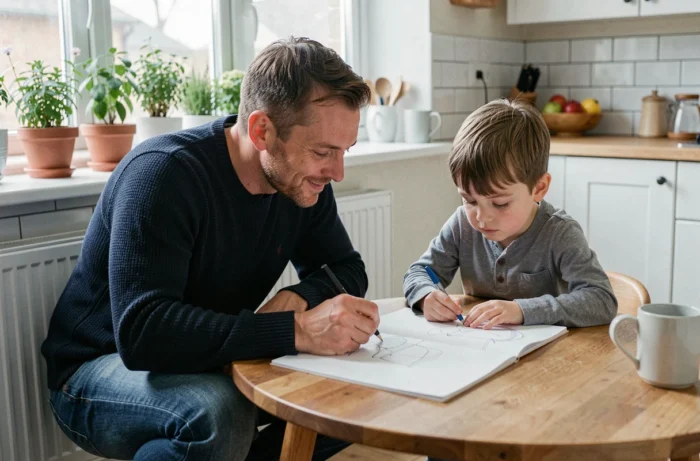
Emotional Regulation in Children: What Daily Life Engages
A child’s ability to manage their emotions is not taught like a school skill. It is co-constructed in the relationship with reference adults. Before the age of three, the prefrontal cortex, responsible for inhibition and planning, is still very immature. Expecting a two-year-old to “manage their frustration” is akin to asking them to use a neurological tool they do not yet possess.
This observation has a direct consequence on parental posture. Anger, intense crying, and oppositional outbursts are not educational failures. They are normal manifestations of a nervous system in the process of maturation.
Co-regulation Posture in Daily Life
We observe that the most effective parents in emotional support share one characteristic: they verbalize the emotion before attempting to resolve it. “You are angry because your toy broke” precedes any attempt at consolation or distraction.
- Name the emotion at the precise moment it occurs, without minimizing (“it’s nothing”) or amplifying (“oh dear, it’s terrible”).
- Maintain a stable tone of voice and a slow breathing rhythm, which the child unconsciously mirrors through physiological synchronization.
- Offer physical contact (hand on the shoulder, proximity) without imposing it, as some children prefer a momentary withdrawal before returning to the adult.
This co-regulation does not need to be perfect in every interaction. It is the repetition across hundreds of situations that builds an internal model of emotional management in the child.
Parental Leave and Parental Presence: A Concrete Lever for Early Childhood
Recent public policies are changing the conditions of parental availability during the most sensitive period of development. The additional birth leave, compensated by Social Security, provides for a compensation of 70% for the first month, then 60% for the second. This level of compensation far exceeds that of traditional parental education leave.
This leave must be taken within nine months following the birth or arrival of the child. The employer must be notified at least one month in advance, or fifteen days if the leave immediately follows a paternity leave.
The interest of this measure goes beyond the simple financial question. Continuous parental presence during the first weeks allows for the establishment of a secure attachment, the foundation of self-confidence and autonomous exploration in the child. A parent who is physically and psychologically available during this period provides a base that subsequent childcare arrangements will complement, not replace.

Daily Environment and Stimulation: Adjusting Without Overloading
The trend to multiply structured activities (musical awakening, baby gym, Montessori workshops) is based on an incomplete understanding of developmental needs. A child between one and three years old learns primarily through free exploration in a secure and sufficiently varied environment.
Creating an Age-Appropriate Space
Layout matters more than the number of toys. We recommend prioritizing a few concrete criteria:
- Offer objects of varied textures, weights, and sizes rather than an accumulation of similar toys, to stimulate fine motor skills and sensory discrimination.
- Alternate between interaction times with the adult and solitary exploration times, respecting the child’s signals of fatigue or disinterest.
- Reduce simultaneous sources of stimulation (e.g., a screen playing in the background during a building game), which fragment attention and hinder emerging concentration.
- Allow the child to experience failure in situations without real danger (a tower of blocks collapsing, a puzzle oriented incorrectly), as the autonomous resolution of micro-problems builds perseverance.
A common pitfall is to confuse stimulation with overload. A child who is bored for a few minutes develops their capacity for initiative. Filling every moment with adult suggestions deprives the child of this internal drive.
Supporting a child’s development on a daily basis does not rely on a single method or specific material investment. The consistency of adjusted interactions, the emotional availability of adults, and an environment that respects the child’s own pace constitute the three strongest pillars that parenting can offer.