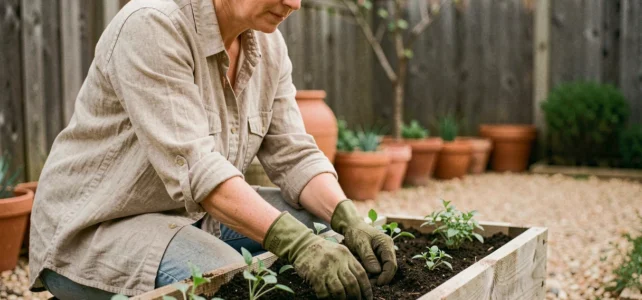
A garden that remains pleasant in January as well as in August does not rely on a stroke of climatic luck. It is based on decisions made long before the first planting: soil analysis, sequencing of tasks, selection of plants suited to the existing soil. Most garden design guides focus on the arrangement of flower beds or furniture. They overlook a step that conditions everything else: the physical diagnosis of the land.
Soil Diagnosis Before Development: Drainage, Slopes, and Buried Networks
Before thinking about plants or the terrace, it is essential to understand how water flows across the plot. Clay soil that retains water in winter turns a lawn into a quagmire and suffocates the roots. Sandy soil drains too quickly and requires more frequent watering in summer.
Observing even slight slopes determines where water stagnates after rain. These wet areas dictate the positioning of pathways, vegetable gardens, and living spaces. Placing a terrace in a natural hollow ensures puddles after every downpour.
Recent recommendations emphasize a precise construction logic: excavation and leveling first, buried networks next, then only hard surfaces (paths, terrace), and finally, the plantings. This sequence prevents the destruction of a freshly planted bed to run a forgotten watering hose.
Administrative constraints also deserve verification in advance. Depending on the municipality, certain fences, garden sheds, or land modifications require prior declaration. Consulting the local urban planning plan before starting work avoids costly surprises.
Resources like the garden on Spot Jardin detail these preparatory steps for different types of soils and configurations.
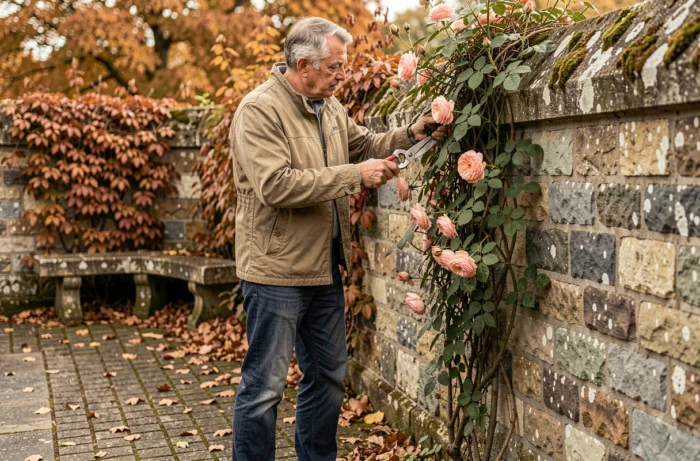
Local Plants and Living Soil: Reducing Maintenance Across Four Seasons
The choice of plants remains the primary lever for a garden that functions year-round without requiring attention every weekend. Plants acclimated to your region and soil type need less water, are more resistant to diseases, and support beneficial wildlife like pollinators.
A Mediterranean shrub planted in Brittany may survive, but it will require winter protection and artificial drainage. In contrast, a local plant establishes quickly and occupies its space without assistance.
Structuring Blooming Seasons
For a garden to remain visually alive from January to December, blooming periods must overlap. The idea is not to accumulate as many species as possible but to select a few complementary plants:
- Winter-flowering shrubs (like winter jasmine or witch hazel) that bring color when the rest of the garden is dormant
- Spring and summer perennials chosen for their drought resistance in regions where summers are increasingly hot
- Ornamental grasses that maintain their structure and golden hue in autumn and winter, ensuring permanent visual interest
- Evergreens (boxwood, yew, photinia) that form the visible green framework even under snow
This principle of seasonal relay transforms a monotonous garden into a space that evolves each month.
Mulching as a Tool for Water and Soil Management
Organic mulching protects the soil, limits evaporation, and nourishes underground life. A sufficiently thick layer of wood chips, fallen leaves, or straw significantly reduces the frequency of watering in summer. It also slows the growth of weeds, which decreases the time spent weeding.
In winter, the same mulch insulates the roots from harsh frosts. It gradually decomposes and enriches the soil with organic matter, improving its structure over the years. Clay soils become more aerated, while sandy soils retain water better.
Permeable Surfaces and Landscaping Materials: Choices That Change Maintenance
The choice of materials for paths, terraces, and borders directly influences long-term maintenance burdens. A terrace made of exotic wood requires annual treatment. Natural stone slabs laid on a sand bed remain stable for years without intervention.
Permeable surfaces absorb rainwater instead of directing it to planted areas or roadways. Stabilized gravel, grass-jointed pavers, or cellular slabs allow water to infiltrate. This choice reduces runoff problems and limits puddle formation in high-traffic areas.
However, feedback on the durability of certain economical solutions varies. Low-quality composite slabs may warp after a few summers of intense heat. Investing in a material suited to the local climate, even if slightly more expensive, avoids premature replacement.
Planning Irrigation by Seasons Without Wasting Water
Irrigation remains the most time-consuming and water-costly maintenance task if nothing is anticipated. A drip irrigation system connected to a timer meets the summer needs of flower beds and vegetable gardens without daily intervention.
Watering early in the morning limits evaporation and fungal diseases. In summer, deep but spaced watering encourages roots to grow deeper in search of moisture, making plants more resistant to drought. Daily superficial watering has the opposite effect: shallow roots that are vulnerable to the slightest oversight.
In autumn and winter, most gardens in temperate climates do not need any additional watering. Potted plants are an exception: their limited soil volume dries out quickly even in cool weather. A weekly check of substrate moisture is usually sufficient.
Rainwater harvesting, via a tank connected to a downspout, provides a free reserve for dry periods. The storage capacity depends on the available roof area and local rainfall, but even a small volume covers the needs for supplementary watering.
A garden designed methodically, with suitable materials and plants chosen for the existing soil, requires less time than a garden designed from a catalog. The initial diagnosis of the soil and drainage conditions the success of everything else, much more than the choice of a rose variety or the color of the borders.