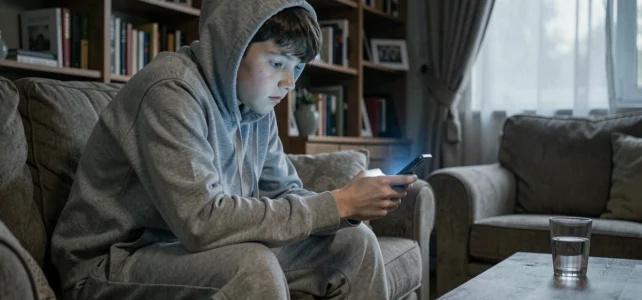
A teenager who spends several hours a day on their smartphone does not automatically fall under the category of addiction. Before setting a framework, we recommend distinguishing between intensive social use (messaging, social networks) and compulsive use with loss of control (inability to stop a session despite visible academic or physical consequences). This distinction conditions the entire subsequent support process.
Application reinforcement mechanisms: what parents need to identify
The interfaces designed for teenagers exploit variable reinforcement loops: intermittent notifications, infinite scrolling, random rewards in games. These mechanisms activate the dopaminergic circuit in the same way as a game of chance. Understanding this functioning allows parents not to reduce the problem to a simple lack of willpower.
The first step is to audit with the teenager the applications that capture the most time. Native screen time tracking tools (Screen Time on iOS, Digital Wellbeing on Android) provide precise data. We regularly observe a significant gap between perceived time and actual time, which serves as an effective awareness lever when approached without judgment.
Some families base their approach on the methods from Maman Anonyme to structure a gradual reduction protocol, starting with the most problematic time slots (evening, homework time).
Mandatory parental control and legal framework in 2026
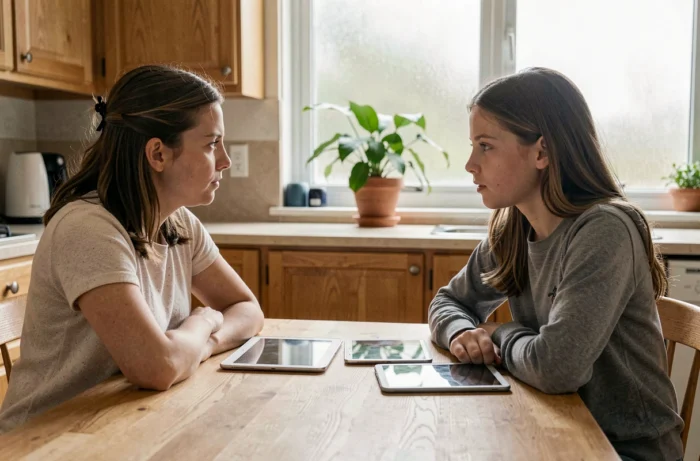
Since July 13, 2024, all new connected devices sold in France must include a freely activatable parental control device. The law requires that this device be offered from the first setup of the device. In practical terms, a parent purchasing a smartphone or tablet is prompted to activate parental control during the initial configuration.
This legal framework provides a support point for families: the teenager can no longer argue that parental control is an exceptional measure, as the legislator has made it systematic.
Another evolution to be aware of: the ban on mobile phones will be extended to high schools in the 2026 school year, including smartwatches and communicative objects. Notifications from educational platforms and school life software are turned off by default between 8 PM and 7 AM, as well as on weekends. This institutional “digital curfew” legitimizes the establishment of screen-free times at home.
- Activate parental control as soon as the device is purchased, involving the teenager in the setup to avoid a sterile power struggle.
- Rely on the cutting off of school notifications in the evening to establish a family rule consistent with the school’s framework.
- Ensure that parental control also covers app stores, as teenagers often bypass restrictions by installing alternative apps.
Progressive screen time reduction protocol
We advise against the abrupt removal of screens. A radical withdrawal provokes an oppositional reaction in the majority of teenagers and deteriorates the parent-child relationship without lasting results.
An effective protocol is based on three phases. The first week serves as a diagnostic: the teenager notes their usage time slots and the associated emotions (boredom, social anxiety, need for stimulation). The second week introduces a targeted reduction in the most problematic time slot, usually smartphone use after 9 PM. The third week expands the restriction to a second time slot.
The key point not to overlook: each freed time slot must be replaced by a pre-identified activity. A teenager who has a screen removed without an alternative will revert to compulsive use by default.

When to consult a screen addiction specialist
A drop in academic performance associated with persistent sleep disturbances justifies a consultation without delay. The primary care physician refers to an addiction specialist or a center specializing in cyber addiction. Dedicated hospital units exist, such as the one at the EPSM Georges Daumezon hospital in Fleury-les-Aubrais, which specifically welcomes teenagers.
The signals that should raise alarms beyond just time spent:
- Disproportionate anger or anxiety when the screen is taken away, even for a short time.
- Gradual abandonment of physical, artistic, or social activities in person.
- Repeated lies about usage time or creation of hidden accounts to bypass restrictions.
- Disruption of circadian rhythm: falling asleep after midnight, difficulty getting up, drowsiness in class.
Consultation is not an admission of parental failure. It allows for an objective and guilt-free assessment that distinguishes between problematic use and true behavioral addiction. The two are not treated in the same way.
Family dialogue and parental posture in the face of digital dependence
The most counterproductive posture is to impose bans while remaining absorbed by one’s own smartphone. We recommend establishing rules that apply to all family members, including adults. A meal without any screens on the table has more impact than a speech about the dangers of digital technology.
Dialogue works better when it focuses on content rather than duration. Asking a teenager what they are watching, who they are playing with, what interests them about a particular content creator opens up a conversation. Repeating that they spend too much time on their phone shuts down the dialogue.
The goal is not to eliminate screens from a teenager’s life. It is to help them develop a capacity for self-regulation that will serve them well after leaving the family home. The parental framework and the school framework (with the cutting off of notifications in the evening and the ban in high school) now converge to support this gradual autonomy.