
Cooking rice in an electric kettle raises a specific technical question: how can a device designed to heat water produce a result comparable to a pot or a rice cooker? The answer lies in a few measurable variables, including the water-to-rice ratio, the resting time after boiling, and the type of grain used.
Electric kettle and rice cooking: what the device really changes
An electric kettle brings water to a boil and then automatically shuts off the heat. This operation imposes a constraint that neither the pot nor the rice cooker shares: the complete absence of prolonged low heat. All cooking relies on the residual heat stored in the water and the walls of the kettle.
This particularity modifies two parameters. The volume of water must be slightly higher than that of a traditional cooking method because rapid boiling causes more evaporation before the grains absorb the liquid. The closed-lid resting time becomes the main cooking phase, not just a simple complement.
Before detailing the ratios by type of rice, it is useful to consult the tips from Gourmet Galopin for rice in a kettle, which also address the choice of the appropriate kettle.
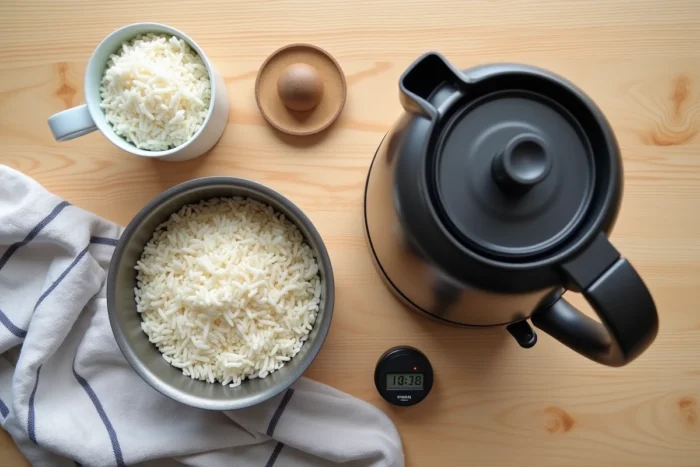
Water-to-rice ratio in kettle according to grain type
The standard measurement of “1 volume of rice to 1.5 volumes of water” works in a pot with continuous low heat. In a kettle, this ratio often results in rice that is still crunchy in the center because the residual heat alone is not enough to finish the absorption. Practical feedback converges towards adjusted proportions.
| Type of rice | Water-to-rice ratio (kettle) | Water-to-rice ratio (pot) | Closed-lid resting time |
|---|---|---|---|
| Long grain white (basmati, Thai) | 2 volumes of water for 1 volume of rice | 1.5 volumes of water for 1 volume of rice | About 10 minutes |
| Short grain white | Slightly higher than pot ratio | 1.25 to 1.5 volumes of water | About 10 minutes |
| Brown / semi-brown | Not recommended in kettle | 2 to 2.5 volumes of water | Not applicable |
Long grain white rice is the most reliable candidate in a kettle. Brown rice does not cook properly with residual heat alone: its bran layer requires prolonged cooking time at maintained temperature, which a kettle cannot provide.
Resting phase in kettle: the real cooking step
In a pot or electric cooker, the post-cooking resting time generally lasts five to ten minutes. Its role is to firm up the grains and finish absorbing the last traces of water. This resting time remains optional for achieving a correct result.
In a kettle, the logic reverses. The closed-lid resting time is the phase where the rice actually cooks. The initial boiling only brings the water to temperature and starts the swelling of the starch. Opening the kettle during this phase lets steam escape, which ensures thermal transfer.
Optimal resting protocol
- As soon as the kettle shuts off automatically, do not open the lid for about ten minutes, or a bit longer if the amount of rice is large.
- Resist the temptation to stir: each opening drops the internal temperature and interrupts absorption.
- After the resting time, lift the lid and fluff the grains with a fork to release excess steam and avoid a mushy result.
This protocol compensates for the absence of low heat. The result directly depends on the seal of the lid: a kettle with a poorly sealing lid will let too much steam escape.
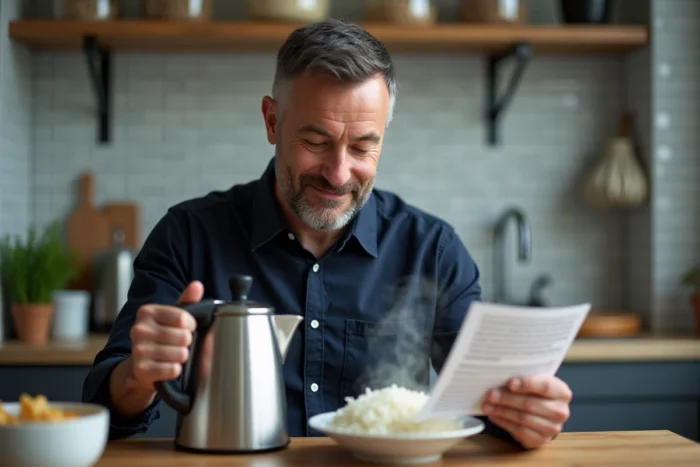
Rinsing rice before cooking in a kettle: a technical imperative
Rinsing before cooking is recommended regardless of the method. In a kettle, it becomes even more crucial. The surface starch released by unwashed grains dissolves in the boiling water and forms a sticky layer that adheres to the inner walls of the device.
Rinsing the rice three to four times until the water runs clear reduces this deposit and facilitates cleaning. This action also improves the final texture: the grains remain more distinct, which partially compensates for the slight excess water imposed by the method.
Cleaning the kettle after use
A point that classic cooking guides do not address: cooking rice in a kettle leaves a film of starch on the heating element and the walls. This residue hardens as it dries.
- Rinse the kettle with warm water immediately after transferring the rice, before the starch dries.
- If a deposit has formed, fill the kettle with water and a splash of white vinegar and bring to a boil, then let cool before scrubbing.
- Do not use an abrasive sponge on the inner walls to avoid damaging the coating.
Neglecting maintenance reduces the lifespan of the kettle and can alter the taste of the water in subsequent uses.
Real limits of cooking rice in an electric kettle
This method works within a specific framework: white rice, small quantity, absence of other equipment. It does not replace a rice cooker for daily use.
The capacity of a standard kettle limits the portion to one or two people. Beyond that, the volume of rice absorbs too much water too quickly, and the residual heat is no longer sufficient to cook all the grains evenly. Exceeding half of the kettle’s capacity results in unevenly cooked rice.
Repeated rice cooking in a kettle also accelerates scaling and aging of the device, especially if post-cooking rinsing is not systematic. For regular use, a small rice cooker remains more suitable and consumes a comparable amount of energy.
Cooking rice in a kettle remains a reliable backup solution as long as a higher water ratio, strict closed-lid resting, and limiting to small quantities of white rice are respected. The grain that comes out of the kettle does not have the texture of high-end rice cooker rice, but it is perfectly edible, and that is often all that is required of it.