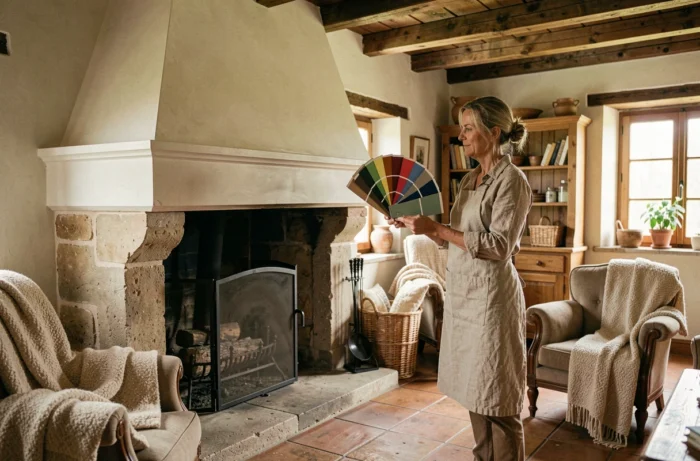
The chimney hood often represents the largest vertical surface in a living room. Choosing the color to paint a chimney hood involves balancing perceived thermal effects, coherence with the surrounding elements, and the durability of the finish against temperature rises. Here, we discuss the technical criteria that guide this choice far beyond just the color chart.
Perceived temperature and color psychology applied to the hood
A hood painted in warm tones (terracotta, ochre, chocolate brown) makes the room feel warmer, regardless of the actual temperature. Recent syntheses in color psychology confirm this phenomenon: warm colors increase the perceived temperature for occupants, while a cool gray or blue would visually cool the area around the fireplace even when it is in use.
This is not trivial. On a surface as dominant as a hood, the perception gap is clear. A golden ochre or a soft yellow enhances the warmth of the fire, while a pure white or bluish gray creates a visual distance from the fireplace. We recommend reserving cool shades for hoods located in very bright rooms where the aim is to downplay the presence of the fireplace.
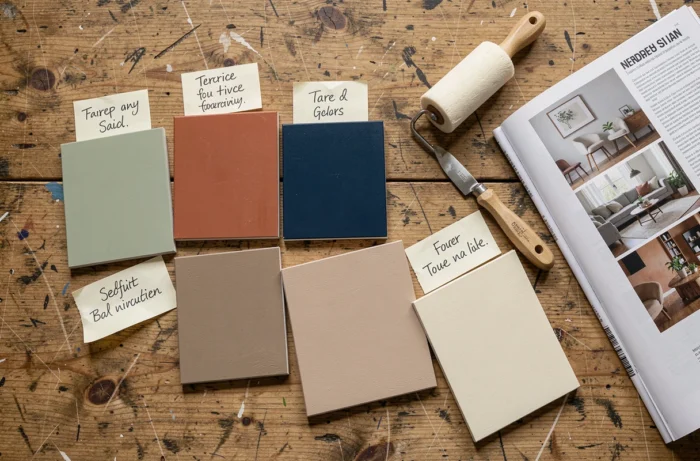
The trend of biophilic design, which favors organic palettes in “cocoon” areas like the living room, also leans towards natural pigments: sienna, deep sage green, sandy beige. These shades interact better with the surrounding stone or brick than a matte black, which is often appealing in photos but can be overwhelming in a modestly sized living room.
To delve deeper into which paint color for a chimney hood is suitable based on your configuration, the question of the substrate is as crucial as that of the hue.
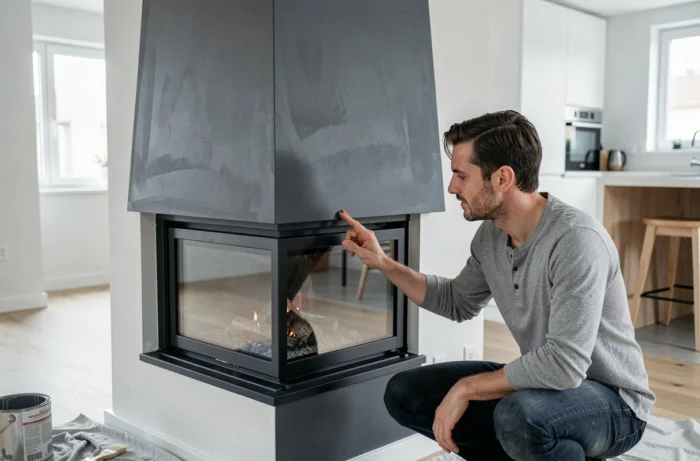
Paint for chimney hood: the substrate dictates the finish
The hood is not an ordinary wall. Depending on whether it is made of plaster, brick, reconstituted stone, or metal, porosity and thermal conductivity vary radically. Applying a standard acrylic paint on a metal duct exposed to heat guarantees peeling within a few months.
Plaster and coating: the most common case
On a healthy plaster coating, a special facade acrylic paint offers a good compromise. It tolerates slight thermal expansions and accepts a long-haired roller that penetrates well into surface irregularities. Two thin coats are better than one thick coat, which traps residual moisture and causes bubbling.
Exposed brick or stone
A porous substrate requires a primer before any coloring. Without this step, the brick absorbs the binder unevenly, resulting in matte areas next to satin ones. The finish is heterogeneous, regardless of the chosen hue. On old brick, we find that matte or velvety finishes better conceal absorption defects than a satin finish, which reveals every imperfection.
Metal and areas near the fireplace
For a metal hood or the upper part of an insert, only a high-temperature paint (resistant to several hundred degrees) is suitable. These products come in black, anthracite gray, and a few limited shades. The color choice is therefore constrained by the technique, not by aesthetics.
Choosing the color based on the brightness and volumes of the living room
Painting a hood is not decided based on an isolated sample. The same shade changes radically depending on the room’s exposure.
- In a north-facing orientation, the cold light pulls grays towards blue and dulls beiges. A warm ochre or a yellow-tinged off-white compensates for this natural bias.
- In a south or west-facing orientation, the golden light of late afternoon already warms the surfaces. A mineral gray or a verdigris works without the risk of saturation.
- In a small living room with a low ceiling, a hood painted in the same shade as the adjacent wall visually erases its volume. Conversely, a contrasting color transforms the hood into a focal point and structures the space.
- Under a cathedral ceiling, a dark shade on the hood anchors the fireplace to the floor and avoids the effect of vertical emptiness.
COV regulations and classification of indoor paints
Professional guides for building painters remind us that paints used indoors must comply with a A+ or A classification for VOC emissions. On a chimney hood, this requirement takes on additional significance: heat accelerates the off-gassing of volatile organic compounds. A poorly classified paint emits more harmful substances when the fireplace is in use.
We recommend systematically checking the environmental label before purchase, even on products marketed as “eco-friendly.” Water-based formulations with very low VOC levels are now the norm for this type of surface.
Matte, satin, or velvety finish: deciding based on use
The level of gloss modifies the perception of color as much as the hue itself.
- Matte absorbs light and conceals surface defects. It is the most common choice for hoods with old coatings, but it gets dirty faster and is harder to clean.
- Satin reflects light slightly and adds depth to dark shades. It is suitable for smooth and well-prepared hoods.
- Velvety (or deep matte) offers a compromise: it is more washable than classic matte while maintaining a soft finish, suitable for warm atmospheres.
On a chimney hood exposed to smoke or soot projections, washability is not a luxury. A pure matte in a light tone will require frequent touch-ups. A velvety finish in a medium shade (warm gray, taupe, olive green) ages better with less maintenance.
The choice of color for a chimney hood relies on three inseparable parameters: the nature of the substrate, the room’s light, and the technical classification of the product. Addressing one without the others yields a disappointing result, even with the perfect shade on the color chart.