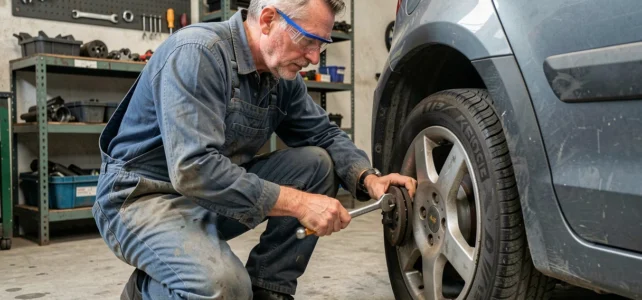
In France, maintaining a car represents a significant expense, especially when income is tight. Solidarity garages offer repairs and maintenance at reduced rates, overseen by professional mechanics. Their model is based on associative structures or, more recently, on initiatives supported by local authorities, with pricing grids adapted to the users’ resources.
Family quotient and social pricing: the new lever for access to solidarity garages
The associative network forms the historical foundation of solidarity garages. In recent years, several intercommunalities and departments have integrated these garages directly into their public mobility services, with a different pricing logic.
The mechanism is based on the family quotient (QF) as a criterion for access to reduced rates. In Oise, a public and solidarity garage applies this logic with a reduced hourly rate for users with a low QF, while others pay the full rate. The discount can reach about 40% for modest households.
This approach changes the game. The traditional associative network generally sets its own eligibility criteria (beneficiaries of social minima, referral by a social worker). With pricing based on QF, access becomes clearer: a CAF or tax document is sufficient. The directory available at https://www.garages-solidaires.fr/ lists existing structures, whether associative or linked to a local authority.
However, not all areas offer this service. Rural areas, where dependence on cars is highest, often remain less covered than urban areas.
Solidarity garage: what a reduced-rate service actually covers
A solidarity garage is not a traditional garage with a commercial discount. The economic model relies on three pillars: public subsidies, membership fees, and partially volunteer or professional-integration labor.
Specifically, the services are divided into two main categories.
Intervention supervised by a professional
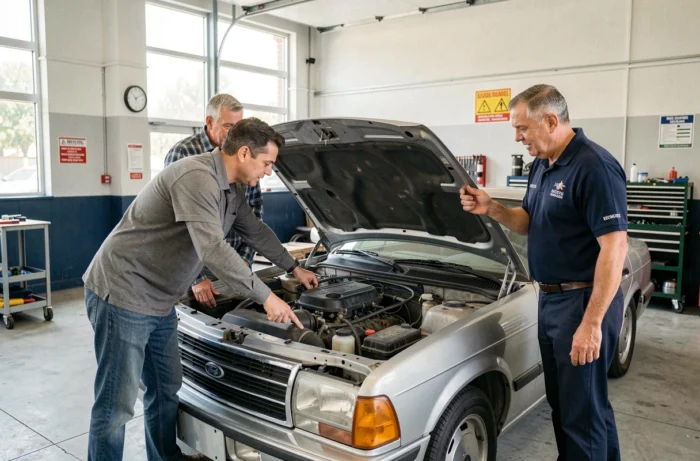
A salaried mechanic from the structure performs the diagnosis and repairs. The hourly rate remains significantly lower than that of a traditional garage. Spare parts are often refurbished used parts, which significantly reduces the overall bill.
Participatory workshop formula
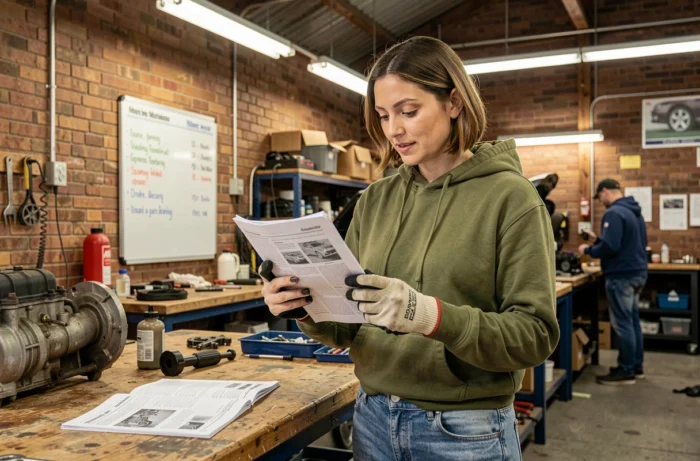
Some structures, sometimes called self garages, provide a lift, tools, and the advice of a supervisor. The user performs the operations themselves (oil change, brake pad replacement, filter replacement). The annual fee varies, depending on the structures, between ten and a hundred euros.
The participatory formula is suitable for people with a minimum of mechanical knowledge. For a complex intervention (clutch, timing), support from a professional remains essential, even in a solidarity framework.
Access conditions and documents required for reduced-price maintenance
Membership in a solidarity garage is generally open to everyone. Maximum discounts are reserved for individuals who can prove modest incomes through specific documents. Selection occurs at the time of pricing, not at the time of registration.
The most frequently requested documents include:
- Family quotient certificate issued by the CAF, which allows the household to be placed in the structure’s pricing grid
- Tax notice or non-tax notice, used by garages that do not apply the QF but check an income ceiling
- Referral by a social worker or an integration structure, in the case of certain associative garages linked to networks like Solidarauto
Some structures also accept temporary workers referred by the FASTT, which has partnerships with solidarity garages across the country.
Known limitations and points of caution before entrusting your car
The solidarity garage is not a universal solution. A few limitations deserve to be clearly stated.
The waiting time is a frequent barrier. These structures operate with small teams and high demand. Obtaining an appointment can take several weeks, which poses a problem in the event of a breakdown that immobilizes the vehicle.
The range of services can sometimes be limited. Air conditioning recharge, complex electronic issues, or windshield replacement may not always be included in the catalog. Solidarity garages mainly cover routine maintenance and basic mechanics.
An article from the Journal de Saône-et-Loire in July 2026 also mentions a dispute over a breakdown diagnosis in a solidarity garage. This type of situation, still marginal, reminds us that the trust relationship between the user and the structure is based on an associative framework, not on the same contractual obligations as a commercial garage. In case of disagreement, recourse options are more ambiguous.
Lastly, the geographical coverage remains uneven. Available data do not allow for a conclusion of sufficient territorial coverage. Large urban areas concentrate the majority of structures, while the need for automotive mobility is often more critical in suburban and rural areas.
The model of the solidarity garage is evolving, between historical associative anchoring and gradual integration into public mobility policies. For a user, the most effective approach remains to check if a structure exists nearby, gather their income documents, and compare the proposed rate with a traditional quote before committing. The price difference almost always justifies the detour.