
The scalp is one of the areas with the highest density of sweat glands. Under a poorly chosen or improperly worn hat, heat accumulates, sweat starts pouring, and discomfort sets in within minutes. Here are eight practical tips for wearing a hat all day without experiencing that pressure cooker effect.
1. Wear a cotton headband under the hat to absorb sweat

In a market under the blazing sun or while hiking, sweat first drips from the forehead to the eyes. A thin strip of cotton placed under the hat captures this moisture before it drips down. You can find tips for an anti-sweat hat on Le Blog de Lalie that confirm the effectiveness of this simple gesture.
The headband has another advantage: it protects the inner band of the hat, which yellows and degrades quickly with direct contact with sweat. Just wash it daily to maintain proper hygiene. Opt for a thin model, without thick seams, to avoid marks on the forehead.
2. Choose a quick-drying fabric instead of just thick cotton
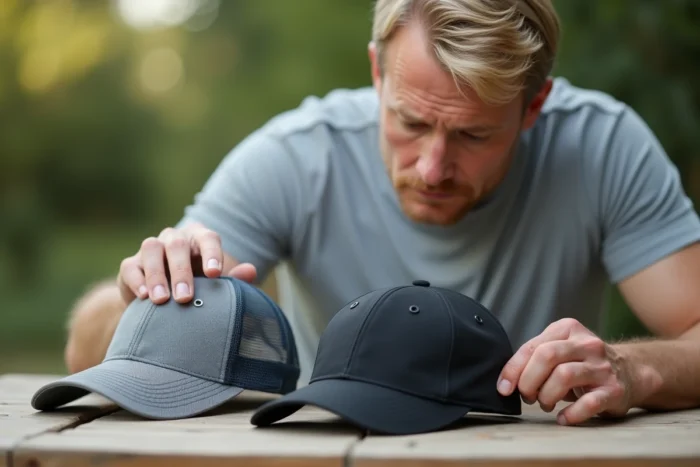
We often think that cotton is sufficient for summer. It absorbs well but dries slowly. The result: after an hour, the hat remains damp and heavy on the head.
Recent technical buying guides now place ultra-fast drying and breathable fabric on the same level of importance as UV protection. Technical microfibers or mesh panels wick moisture away instead of trapping it. The feeling of a “boiling head” decreases significantly, as do the visible sweat halos on the hat.
3. Leave a finger’s width between the hat and the skull

A hat that is too tight presses the fabric against the scalp, blocks airflow, and accelerates temperature rise. Japanese dermatologists recommend maintaining about a finger’s width of margin between the band and the skull.
This sizing detail has consequences beyond thermal comfort. A hat that is too snug increases the risk of micro-inflammations and can worsen scalp fragility in individuals already experiencing hair loss. When between two sizes, it’s better to choose the larger one and adjust with a cord or tightening system.
4. Remove the hat as soon as you go indoors

We often keep the hat on out of habit when entering a store or restaurant. The scalp remains trapped for no reason, and the accumulated moisture does not dry. Scalp specialists recommend removing the headgear as soon as you are out of the sun, to allow the skin to dry naturally.
This reflex also reduces bacterial proliferation in the inner band. A hat worn continuously, both indoors and outdoors, becomes a breeding ground for odors and skin irritations.
5. Clean the inner band at least once a week

The mixture of sweat, sebum, and hair product residues accumulates in the band day after day. This combo of hat, sweat, and greasy products promotes forehead acne and skin irritations. A weekly cleaning of the band with a little mild soap is enough to limit these effects.
For hats worn daily in the height of summer, you can increase the frequency. Ideally, dampen the band with a cloth each evening, then do a complete wash at the end of the week. Feedback varies on this point depending on the materials, but the principle remains the same: do not let dirt settle in.
6. Prefer wide-brimmed hats with ventilation eyelets

A narrow-brimmed hat poorly protects the neck and ears, areas where heat also accumulates. Wide-brimmed models create a larger shaded area and reduce the perceived temperature around the face.
Eyelets or mesh panels on the crown radically change ventilation. Without them, air stagnates under the hat. With them, a natural airflow is established, accelerating sweat evaporation. For a full day outdoors, this is the criterion that makes the biggest difference in comfort.
7. Avoid greasy hair products before wearing a hat

Wax, gel, hair oil: these products form a film that prevents the scalp from breathing properly. Under a hat, heat softens these products, which migrate to the forehead and clog pores.
For a day in the sun, it’s best to style your hair without greasy products, or to use a light water-based spray. The scalp sweats less, the hat’s band stays cleaner, and the risk of skin eruptions decreases. Here are the products to avoid before wearing a hat in summer:
- Waxes and pomades made from petroleum jelly or beeswax, which melt in heat and clog pores
- Hair oils applied at the roots, which create an occlusive layer under the fabric
- Strong-hold gels, whose sticky residues transfer to the inner band
8. Alternate two hats throughout the day to let the first dry

When spending eight hours outdoors, a single hat ends up soaked by midday. Bringing a second model allows for rotation: while wearing one, the other dries in the open air, turned upside down on a bag or hanging from a branch.
A dry hat protects better and remains more comfortable than a hat saturated with moisture. This rotation works particularly well while hiking or at a festival, where you wear headgear from morning to night. Two lightweight hats made from technical fabric weigh less than a single thick felt hat and cover an entire day without discomfort.
Managing sweat under a hat relies more on choices of material, size, and maintenance than on a miracle model. A breathable fabric, a fit that is neither too tight nor too loose, and a regularly cleaned band are enough to transform wearing a hat in summer.