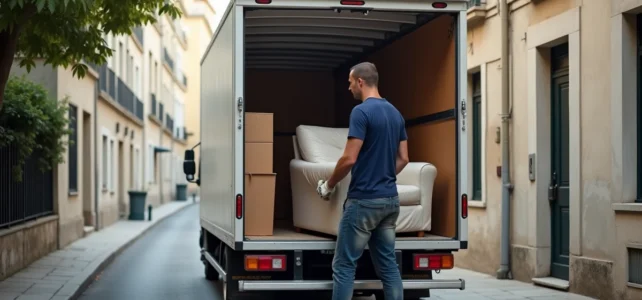
Moving a two or three-room apartment requires a quick decision: which truck to rent? The 15 m³ truck consistently appears in recommendations, and for good reason. This volume corresponds to the most suitable size for a home of about 50 m², provided you understand what its actual dimensions entail. Because between two models that display the same cubic capacity, the usable length, width, and height can vary enough to turn a smooth loading process into a headache.
Interior dimensions of the 15 m³ truck: why the numbers vary from one rental company to another
Have you ever compared two technical sheets for 15 m³ trucks? The discrepancies can be surprising. One model may have a shorter usable length but a more generous interior height, while another prioritizes width at the expense of height.
This difference is due to the vehicle’s chassis. Rental companies offer utility vehicles from different brands and series. The advertised volume (15 m³) is a commercial rounding. Two boxes can have the same total cubic capacity with very different proportions.
In practice, what matters for a move is the interior width between the wheel arches. This dimension determines whether you can slide a sofa, a mattress, or a table flat without tilting it. Before booking, ask the rental company for this precise measurement, not just the overall volume. To better understand the dimensions of a 15m³ moving truck, you need to look beyond the simple displayed cubic capacity.
The usable height also deserves your attention. A standard refrigerator measures between 170 and 185 cm. If the truck’s interior height falls below this value, you will have to lay the appliance down, complicating stabilization and increasing the risk of damage.

15 m³ truck and total authorized weight: the trap of the B license
Volume is not everything. One point that many renters discover too late concerns the total authorized weight (PTAC). Almost all 15 m³ trucks available for rent remain under the 3.5-ton threshold, making them accessible with a standard B license.
The trap lies in the remaining payload. Once the weight of the empty vehicle is deducted from the PTAC, there is often between 1,000 and 1,300 kg of actual capacity left. This seems comfortable, but a complete move from a furnished 50 m² apartment can easily reach this limit, especially with books, appliances, or heavy equipment.
- Weigh your boxes of books: a few well-filled boxes can quickly add up to several hundred kilos on their own.
- A washing machine, refrigerator, and combined oven often weigh as much as ten standard boxes.
- Solid wood furniture (bookshelves, buffets, wardrobes) is heavier than one might think, sometimes double that of particle board furniture.
Exceeding the PTAC exposes you to a fine and voids the rental company’s insurance coverage. A quick inventory by weight category before the big day avoids this unpleasant surprise.
Living space and actual volume: the ratio that changes everything
Classic guides associate a truck’s volume with a number of rooms. A T2 would correspond to 10-12 m³, a T3 to 15-20 m³. This grid has the merit of simplicity, but it masks a determining parameter: the density of furniture varies greatly from one household to another.
A minimalist 50 m² apartment, with a sofa, a bed, and a few shelves, will fit into 10 m³. The same apartment occupied by a family with a library, dining table, office, stroller, and filled cellar will exceed 15 m³.
Rather than reasoning by type of housing, start from the living area as a starting point, then adjust according to three concrete criteria:
- Presence of a cellar or garage whose contents add to the main living space.
- Number of bulky furniture items (corner sofa, double bed with slatted base, wardrobe over two meters).
- Estimated number of boxes: each cubic meter of stacked boxes corresponds to about five to six standard boxes.
The 15 m³ truck covers the majority of moves from a properly furnished home around 50 m². Beyond that, it is better to consider a 20 m³ truck rather than cramming the load or planning a second trip.

Low emission zones and the dimensions of the 15 m³ truck: a recent constraint
Since the gradual implementation of low emission zones (ZFE) in several French metropolitan areas, the choice of moving vehicle is no longer limited to volume. The truck’s Crit’Air sticker determines whether it can circulate in the designated area on your moving day.
Recent rental trucks are generally classified as Crit’Air 1 or 2, which is not a problem. However, an older utility vehicle rented between individuals may be prohibited from circulating in the city centers of Toulouse, Lyon, Paris, or Marseille, among others. Check the sticker before signing the rental contract.
The external dimensions of the 15 m³ truck also play a practical role in the city. Its total length often exceeds six meters. Double parking in a narrow street to load or unload can block traffic and lead to a ticket. Some municipalities grant temporary parking permits for moving, which should be requested a few days before the scheduled date.
Loading a 15 m³ truck: the order that protects your belongings and your back
A good loading strategy utilizes every available cubic centimeter while protecting fragile items. The principle is simple: heavy and flat items at the bottom, light boxes on top.
First, place the heaviest appliances and furniture against the back wall, near the cabin. They serve as a support wall. Mattresses and box springs are then slid vertically along the side walls, where they play a dual role of protection and space-saving.
Boxes are loaded last, stacked from heaviest to lightest. Fill empty spaces with blankets, cushions, or soft bags. A dense and well-secured load reduces movement during transport, minimizing breakage.
If the rental company offers tie-down straps, use them consistently. Sudden braking can shift a poorly secured load by several dozen centimeters, enough to crush a fragile box or destabilize a stack.
The 15 m³ remains the most versatile format for a medium-sized move. Check the exact interior dimensions, monitor the available payload, and adjust the volume to the actual contents of your home rather than a theoretical grid by the number of rooms. It is the combination of these three checks that makes the difference between a single trip and an expensive round trip.